

How to Find Customers of a Company Early

How to Find Customers of a Company—and Spot the Right Buyers

To learn how to find customers of a company, start with its case studies, customer pages, and testimonials. Check each name against the customer's own website, recent announcements, or public records. Record the source and date, and make sure the company is a customer—not a partner, investor, or past prospect.
For career and executive coaches, the goal is not to copy a customer list. It is to learn who buys a service like yours, then look for signs that a potential client needs help now. Individual coaching clients may not be named publicly, so treat public lists as clues, not proof of buying intent.
I'm Kent Vanho, founder of Alpha Coast, where I've helped more than 400 coaches, recruiters, and consultants build lead pipelines. My approach to how to find customers of a company starts with checking buyer fit and intent before outreach.

The Core Public Channels: How to Find Customers of a Company
When you want to identify who purchases from an enterprise or competitor, you do not have to guess. Organizations leave digital footprints across the web confirming commercial relationships.
The trick lies in knowing where to look and assessing the strength of evidence. Not every source carries equal weight. A logo on a website might be outdated, whereas a regulatory filing carries legal accountability.
Source Type | Proof Level | Data Reliability | Extraction Effort | Primary Use Case |
SEC 10-K Filings | Highest (Legal) | 95%–100% | Low to Moderate | Identifying major enterprise accounts (>10% revenue) |
Public Procurement / Contracts | High (Audited) | 90%–95% | Low | Verifying government and public sector vendors |
Case Studies & Whitepapers | High (Verified) | 85%–90% | Moderate | In-depth buyer persona and use-case mapping |
Technographic Tracking | Moderate (Code-level) | 75%–85% | Low (Automated) | Identifying live software and tool adoption |
Website Logo Strips | Moderate to Low | 60%–70% | Low | Surface-level prospecting lists |
Review Platforms (G2, TrustRadius) | Moderate | 70%–80% | Moderate | Uncovering user sentiment and company affiliations |
Using a disciplined multi-source verification framework helps you avoid bad data. Understanding the fundamentals of what is client acquisition ensures you don't just harvest cold company names, but build pipelines that generate real opportunities.
Mining Seller Websites for Case Studies, Testimonials, and Logo Strips
The primary seller’s website is the fastest starting point for intelligence gathering. B2B firms use social proof to build credibility with prospective clients.
Look for several key sections:
The "Customers" or "Clients" Hub: Many firms maintain directories of client success stories. A detailed study of Lattice showed that out of 132 public names discovered across multiple sources, 59 came directly from its customer hub and 11 from its homepage logo strip.
In-Depth Case Studies: These assets provide customer names, problem statements, buying criteria, and implementation metrics.
Customer Review Aggregators: Platforms like FeaturedCustomers curate validated case studies, hosting approximately 2,000 customers for SAP, 1,500 for Sage, 1,000 for Alteryx, and dozens for niche providers.
Press Releases: Search the company's newsroom for commercial partnership declarations or customer wins.
When organizing these lists, pair each account with actionable tactics on how to find customers to sell to to convert names into conversations.
Examining Regulatory Filings and SEC 10-K Disclosures
Public enterprises operating under regulatory authorities like the U.S. Securities and Exchange Commission (SEC) must disclose material dependencies.
Under GAAP and SEC rules, if a single client accounts for 10% or more of total consolidated revenue, the business must state this concentration in its annual Form 10-K filing.

Consider AI infrastructure provider CoreWeave. In regulatory reports, it disclosed recognizing roughly 67% of its 2025 revenue from its single largest client, Microsoft, alongside multi-billion-dollar deals with OpenAI ($6.5 billion) and Meta ($14.2 billion).
Academic and commercial researchers use these disclosures to track supply chains and client concentration. You can review detailed research on customer intelligence filings to explore how these filings inform competitor evaluations.
Reverse Engineering from the Buyer: Tech Stacks, Jobs, and Contracts
Relying only on the vendor's disclosures shows an incomplete picture. Some vendors avoid publishing customer names to prevent poachers, or they sign non-disclosure agreements. To bypass this, examine the customer's own digital presence.

This buyer-side discovery strategy aligns directly with modern customer acquisition and retention strategies by highlighting accounts with verified, active needs.
How to Find Customers of a Company Through Job Postings and Tech Stacks
When an enterprise adopts a specialized tool, its daily operations change. These internal changes generate clear signals:
Job Descriptions and Responsibilities: When organizations hire managers or engineers, they list daily tools. A posting asking for "experience managing HubSpot CRM migrations" or "proven expertise with Workday HCM" confirms that the business uses those solutions.
Technographic Intelligence Engines: Platforms like BuiltWith detect underlying scripts, tracking pixels, and server tools. BuiltWith identifies more than 300,000 live sites using HubSpot technologies.
Engineering and Architecture Blogs: Technical teams frequently detail their software stacks, vendor partnerships, and architecture changes on platforms like Substack, Medium, or proprietary developer portals.
Pairing technographic data with practical playbooks on how to get new clients lets you reach out with direct context on a prospect's operational setup.
Auditing Government Procurement and Public Contract Databases
Public institutions, military divisions, and educational systems publish their vendor spending to ensure transparency.

By searching databases like USAspending.gov or municipal expenditure dashboards, you can view exact vendor contracts, funding sizes, and project scopes. These records provide definitive proof of purchase.
Verification and Data Hygiene: Classifying Genuine Accounts
Building a raw list is only the first step. Unverified lists generate false positives, leading to wasted sales outreach.

Maintaining clean data is central to the systematic acquisition of new customers.
Customer vs. Partner vs. Investor: Avoiding Categorization Traps
One common mistake in competitive intelligence is mixing up different business relationships:
Customer: An entity that pays money to use a product or service.
Partner / Channel Reseller: An entity that integrates, resells, or co-markets a solution without necessarily using it internally.
Investor: An entity providing capital in exchange for equity.
Prospect / Beta Tester: An account that trialed a tool without completing a commercial purchase.

Always verify that a named relationship involves a clear buyer-seller transaction.
A 5-Point Checklist to Confirm Active Client Relationships
To verify an account before adding it to your pipeline, run it through this five-point check:
Exact Entity Validation: Does the name refer to the specific operating entity or an unrelated subsidiary?
Commercial Proof: Is there a public quote, case study, contract record, or spend ledger confirming a commercial transaction?
Relationship Currency: Has the client referenced the vendor within the past 12 to 18 months, or is the relationship obsolete?
Primary Source Integrity: Can you trace the relationship back to a primary URL (a corporate newsroom, 10-K, or procurement sheet) rather than a third-party aggregator?
Logged Verification Links: Did you save the direct source URL alongside the account name in your CRM?
Scaling Intelligence and Automation Across Multiple Companies
Manual research works well for niche investigations, but tracking dozens of competitors or hundreds of accounts requires automation.
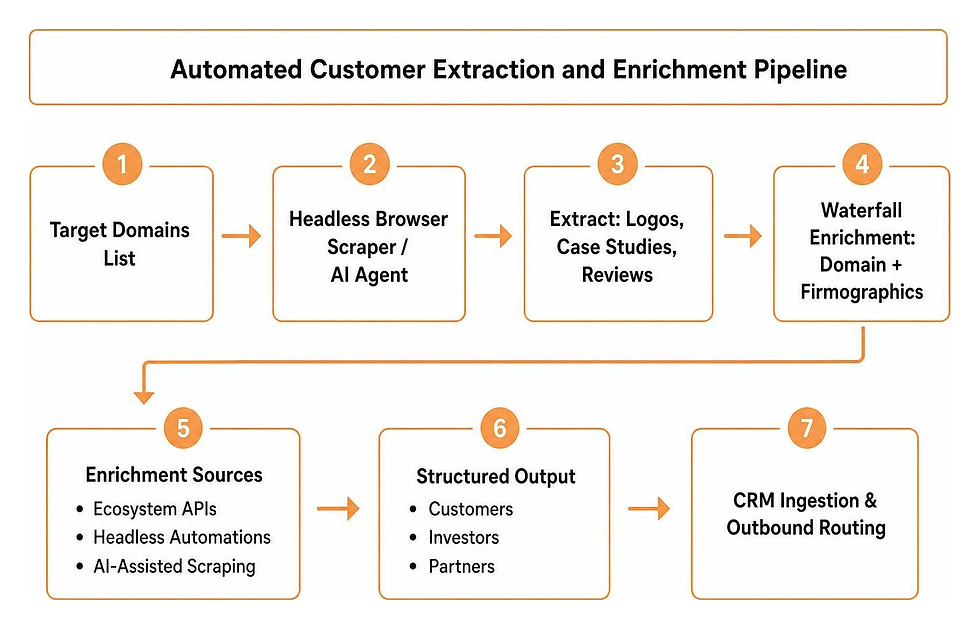
Modern business development teams use automated scrapers, APIs, and waterfall enrichment workflows to pull data from multiple providers. For a broader look at modern pipeline strategy, explore our comprehensive ultimate client acquisition guide 2026.
Automated Web Crawlers, APIs, and Data Enrichment Workflows
Instead of manually checking individual websites, teams use programmatic tools:
Ecosystem APIs: Dedicated platforms like the customer listing data endpoint extract structured data on customers, investors, and partners using live search indexes.
Headless Browser Automations: Developer frameworks like Airtop Studio spin up browser instances to navigate complex layouts, handle pagination, and collect case study details.
AI-Assisted Scraping Agents: Teams run SaaS customer extraction workflows using targeted prompts to crawl homepages, news releases, and client pages, returning clean, structured JSON:
How to Find Customers of a Company in the Private Sector Without SEC Data
Private organizations do not file public SEC reports. Finding their customers requires cross-referencing qualitative footprints:
Professional Network Searches: Search LinkedIn for profiles that mention working with the target vendor in their roles or project descriptions.
Review Aggregators: Check platforms like G2, Capterra, and TrustRadius. Reviewers often share their company name, industry, and organization size.
Social and Community Discussions: Search industry discussion groups and Reddit forums. Buyers regularly ask for advice or share feedback about specific products.
Frequently Asked Questions About Finding Customers of a Company
Is it legal to collect customer lists from public websites?
Yes. Collecting factual business information published on public web pages is generally permissible under corporate research practices.
However, you must respect website terms of service, avoid bypassing authentication walls, and comply with data privacy frameworks like GDPR and CCPA when gathering personal contact details.
Why do annual reports list "Customer A" instead of a named company?
Regulatory rules require public companies to reveal when a customer accounts for 10% or more of total revenue. However, standard accounting rules allow the company to keep the specific customer name private to protect competitive trade secrets.
Researchers often identify these anonymous customers by matching reported revenue amounts with known supplier arrangements or public contract sizes.
How can I convert a company's customer list into active sales opportunities?
Avoid reaching out with generic cold pitches. Instead, look for timing triggers, such as:
Contract renewal dates (often 12, 24, or 36 months after the initial case study was published).
Executive leadership changes at the target company.
Reported technical issues or price increases with the incumbent vendor.
Reach out with helpful migration plans or solutions that address the specific limitations of their existing setup.
Conclusion
Finding the customers of a target company is one of the most effective ways to understand market demand, map out competitors, and identify active buyers.
By analyzing primary seller websites, tracking regulatory filings, and auditing job postings and public contracts, you can build a reliable list of high-intent accounts.
At Alpha Coast, we know that building lists is only the first step. Turning data into predictable revenue requires reaching decision-makers when they are ready to buy.
Our done-for-you Client Accelerator system helps career and executive coaches consistently identify and engage high-intent clients. If you want to replace manual prospect hunting with a reliable pipeline, review our proven system on how to get coaching clients and scale your practice today.


Comments