

From Solo to CEO: A Coaching Business Development Guide

Why Most Coaches Hit a Revenue Ceiling — and How to Break Through It

Coaching business development is the process of building the systems, strategies, and pipelines that turn a solo coaching practice into a predictable, scalable business.
Here's what that looks like in practice:
Step | What It Means |
1. Clarify your niche | Define exactly who you help and what result you deliver |
2. Build your offer | Package your coaching around a specific, high-value transformation |
3. Create a pipeline | Generate leads consistently through outbound, content, or referrals |
4. Systemize sales | Run structured discovery calls that convert prospects into clients |
5. Scale delivery | Move from 1:1 sessions to group or hybrid models without burning out |
6. Track and optimize | Measure key metrics and adjust what isn't working |
Most coaches are great at coaching. The hard part is building a business around it.
The global coaching industry hit $5.34 billion in revenue in 2025, according to data from the International Coaching Federation (ICF), with over 122,000 practitioners competing for clients. At the same time, 33% of organizations now have a dedicated coaching budget — meaning demand is real. But with more coaches entering the market every year, running on referrals and word of mouth is no longer enough.
The coaches who break past the $5K–$8K/month plateau are not the ones who coach better. They're the ones who treat client acquisition like a system, not an afterthought.
That's exactly what this guide is built for.
I'm Kent Vanho, founder of Alpha Coast, where I've spent the past several years helping 400+ career and executive coaches build predictable inbound pipelines through done-for-you coaching business development systems. In that time, I've seen what separates coaches who scale from those who stay stuck — and it almost never comes down to coaching skill.
Let's walk through the full picture.

Defining Coaching Business Development: Beyond General Business Coaching
When we talk about coaching business development, we aren't talking about "working on your mindset" or "improving your leadership style." While those are valuable, they fall under the umbrella of general business or executive coaching.
True business development is an operational discipline. It is the set of systems and activities that predictably fill your client roster without relying on luck, algorithms, or hope. It focuses specifically on revenue generation, sales systems, and expanding market reach. Unlike general coaching, which might look at how you manage your team, business development looks at how you acquire the capital to pay that team.

For many practitioners, the transition into Business Development Coaching is the first time they treat their practice like a machine rather than a craft. This involves moving away from hourly billing and toward value-based packages that reflect the transformation you provide.
Why Coaching Business Development is Essential in 2026
As we navigate through May 2026, the coaching market has reached a fever pitch. With over 122,000 global practitioners, the "credibility barrier" has never been higher. Prospective clients are no longer looking for a "life coach" or a "general business coach"; they are looking for specialists who solve "surgery-level" problems—urgent, painful, and specific issues that require expert intervention.
Digital transformation has also shifted the landscape. In 2026, Business Coaching Growth is heavily tied to how well you integrate AI and automated systems into your outreach. If you are still manually sending LinkedIn connection requests one by one without a data-driven strategy, you are being outpaced by firms using generative AI for personalized branding and sophisticated lead scoring.
Key Differences Between Executive and Business Development Coaching
It is easy to confuse the two, but the outcomes are vastly different:
Executive Coaching: Focuses on soft skills, emotional intelligence, team dynamics, and leadership performance. It helps a leader be better.
Business Development Coaching: Focuses on client acquisition tactics, pipeline predictability, and market dynamics. It helps a business grow bigger.
A Business Development Coach Ultimate Guide would emphasize that while an executive coach helps you manage the people you have, a business development expert helps you find the clients you need.
The Strategic Framework for Scaling a Coaching Practice
Scaling isn't about working more hours; it’s about increasing the "yield" of every hour you spend. At Alpha Coast, we utilize a Growth Operating System that moves coaches away from the "post and pray" method of social media marketing.
Core Pillars of a Coaching Business Development Program
To achieve Coaching Business Success, your development program must cover these fundamental pillars:
Niche Definition: Moving from "I help business owners" to "I help SaaS founders scale from $1M to $3M ARR."
Intellectual Property (IP): Defining your proprietary framework. Clients don't buy your time; they buy your unique process for solving their problem.
Product Design: Creating tiered offers that allow for different levels of access and price points.
The PATH Framework:
Proposition & Pitch: Crafting a message that resonates with the top 3% of the market.
Action Plan: A 90-day roadmap for outbound and inbound activity.
Targeting: Identifying exactly where your high-intent prospects live.
Holding Accountability: The engine that turns intentions into measurable results.

Choosing the Right Model: 1:1, Group, or Hybrid
One of the biggest hurdles in coaching business development is the delivery model. If you only offer 1:1 coaching, you will eventually hit a time ceiling.
Model | Scalability | Profit Margin | Client Intimacy | Best For |
1:1 Coaching | Low | High (per unit) | Very High | High-ticket executive work |
Group Masterminds | High | Very High | Medium | Scaling a proven methodology |
Hybrid (Group + 1:1) | Medium | High | High | Mid-tier growth programs |
Most successful coaches start with 1:1 to refine their methodology and then transition into hybrid models to increase their "Owner Freedom" while maintaining high client results.
Mastering Acquisition and Predictable Pipelines
The "lone wolf" era of coaching is ending. To survive in 2026, you need a predictable pipeline. This starts with a rock-solid Ideal Client Profile (ICP). Your ICP should be so specific that if you changed even one variable, you would have to rewrite your entire marketing pitch.
Solving the "Owner as Bottleneck" Syndrome
Many coaches suffer from becoming the primary salesperson, service provider, and administrator all at once. This leads to "execution collapse." To break this, we implement process automation for repetitive tasks like invoicing, scheduling, and onboarding.
According to a Business Development Service analysis, coaches who use structured discovery call frameworks—diagnosing pain and tying price to ROI—report significantly higher conversion rates than those who treat the call like a casual interview.
Advanced Lead Generation and Social Selling
In the current landscape, a single touchpoint is rarely enough. Research shows that high-ticket buyers typically require 5 to 8 touchpoints before making a decision. This is why we focus on:
LinkedIn Authority: Not just posting, but using LinkedIn as an amplifier for your expertise.
Cold Email Infrastructure: Using warmed domains and personalized, soft-ask openers (keeping them under 100 words).
Multi-touch Sequences: Following up on day 3, 7, and 14 with value-based content rather than "just checking in."
For a deeper dive, check out our Business Development Consulting Complete Guide.
Measuring ROI and Maximizing Results
Investing in coaching business development isn't an expense; it's a strategic investment with measurable returns.
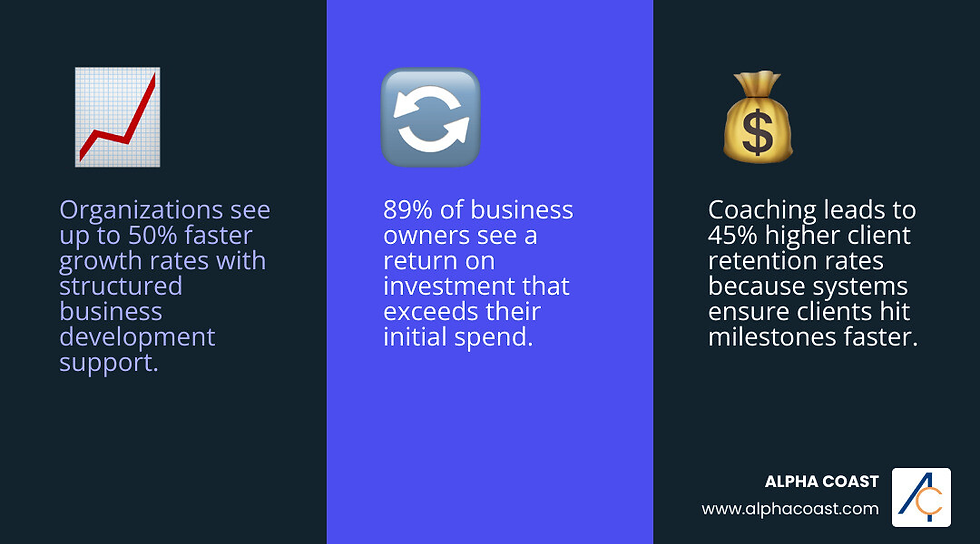
The statistics are compelling:
Organizations can see up to 50% faster growth rates with structured business development support.
Coaching leads to 45% higher client retention rates because the systems ensure clients hit milestones faster.
89% of business owners see a return on investment that exceeds their initial spend.
Customizing Development for Founders and Executives
A Business Development Guide for Career Coaches looks different than one for corporate executives. Founders often need help with "investor readiness" and scaling operations, while executives focus on brand authority and strategic visibility within their industry.
We help our clients build "Category of One" positioning. This means you aren't competing on price; you are the only logical choice for a very specific problem. This is the core of our Business Growth Coaching Ultimate Guide.
Best Practices for Long-Term Coaching Business Success
To maintain momentum, we recommend:
Setting SMART Goals: Specific, Measurable, Achievable, Relevant, and Time-bound.
Data-Driven Strategy: Tracking your reply rates (aim for 5-15% on outreach) and your discovery-to-proposal rate (aim for >40%).
Continuous Learning: Staying updated on generative AI applications for marketing and efficiency.
Ethical Standards: Maintaining high confidentiality and transparency in all sales processes.
Our Coaching Business Accelerator Complete Guide provides the roadmap for maintaining these standards while scaling.
Frequently Asked Questions about Coaching Business Development
How long does it take to see measurable results from business development coaching?
While you may see initial insights and mindset shifts within the first month, tangible metrics like increased lead flow and revenue typically manifest within 3 to 6 months of consistent implementation.
What is the difference between a marketing coach and a business development coach?
A marketing coach focuses on "top of funnel" activities—awareness, branding, and social media presence. A business development coach focuses on the entire "revenue engine," including active pipeline creation, sales closing techniques, and referral systems.
Is certification necessary for business development coaching?
While not legally mandatory, certifications (such as those from the International Coaching Federation (ICF)) provide significant credibility and access to professional networks. However, in business development, your "track record" and proven case studies often carry more weight than a certificate alone.
Conclusion
The journey from a solo practitioner to a strategic CEO is paved with systems, not just "better coaching." By 2026, the coaches who thrive will be those who embrace Business Development Coaching Guide principles to build predictable, repeatable revenue.
At Alpha Coast, we specialize in removing the "hustle" from your growth. Our Client Accelerator system is designed to identify and acquire the top 3% of "ready-to-buy" clients so you can stop worrying about where the next lead is coming from and get back to the work you love.
Ready to stop waiting for referrals and start building a real pipeline? More info about why to choose us can be found here. Let's turn your practice into the machine it was meant to be.


Comments