

The Ultimate Guide to Expanding Your Coaching Empire

Open uping Growth: Your Guide to Expanding Your Coaching Practice

To effectively grow coaching practice, you need a clear strategy. Many coaches struggle to consistently attract clients, even with excellent skills. This guide will show you how to build a thriving business.
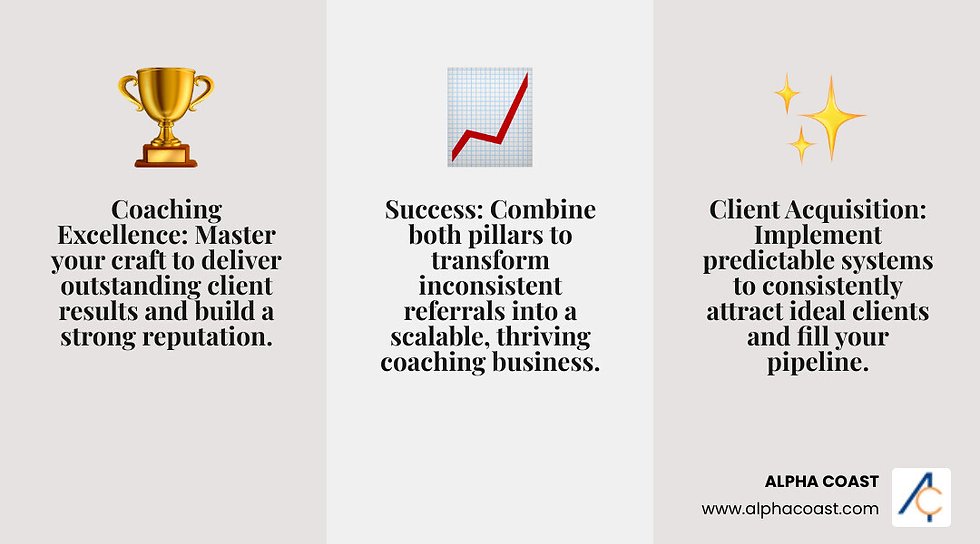
The key to growing a coaching practice involves two main pillars:
Coaching Excellence: Continuously improve your coaching skills and client results. This builds your reputation and generates referrals.
Client Acquisition: Implement reliable systems to find and attract ideal clients. This creates a predictable pipeline for your business.
This guide will walk you through these essential areas. We'll help you move from inconsistent referrals to a scalable, systemized approach.
I'm Kent Vanho, founder of Alpha Coast. My firm specializes in helping coaches like you build predictable inbound pipelines, ensuring you effectively grow coaching practice through scalable, systemized client acquisition strategies. Now, let's explore how to build and scale your coaching business.
Foundational Pillars of a Thriving Coaching Practice
Building a successful coaching practice is much like constructing a robust building; it requires solid foundations. Before we dig into the specifics of coaching methodologies or client acquisition tactics, we need to establish the core principles that will support your growth. This involves defining your unique position in the market, articulating your value, and cultivating a mindset geared for business success.
Defining your niche is paramount. In a crowded market, being a generalist can make you invisible. Who do you serve best? What specific problems do you solve? Once you answer these questions, you can begin building a personal brand that resonates with your ideal clients. Your brand isn't just a logo; it's the sum of your reputation, your values, and the unique experience you provide.
Developing a business mindset is crucial. Many coaches are passionate about helping others but may not initially view themselves as entrepreneurs. However, to truly grow coaching practice, you must accept the roles of leader, strategist, and administrator. This shift in perspective empowers you to make strategic decisions about your practice's direction.
Finally, creating a compelling value proposition clarifies why a client should choose you. What tangible and intangible benefits do clients gain from working with you? A clear value proposition helps you communicate your impact effectively and differentiates you from others.

Foundational Strategies to Grow Your Coaching Practice
To kickstart your growth, we recommend focusing on several foundational strategies. First, identifying your ideal client is non-negotiable. Who are they? What are their challenges, aspirations, and demographics? The more specific you are, the easier it becomes to find and connect with them.
Next, craft your unique coaching offer. This isn't just a list of services; it's a packaged solution to your ideal client's specific problems. What change do you offer? How is it different from what others provide?
Setting clear income and impact goals provides a roadmap for your business. Do you want to serve a few high-value clients, or many clients at a lower price point? What kind of impact do you want to make in the world? These goals guide your marketing and business development efforts.
Building an online presence is no longer optional. This includes a professional website, an optimized LinkedIn profile, and strategic use of social media platforms where your ideal clients spend their time. This digital footprint serves as your 24/7 advocate, showcasing your expertise and attracting potential clients.
Our expert team at Alpha Coast specializes in helping coaches like you build and optimize these crucial elements. You can learn more about us and our approach here: More info about our expert team.
The Importance of Coaching Excellence
Your ability to grow coaching practice hinges on the results you deliver. Client results are your most powerful marketing tool. When clients achieve significant breakthroughs, they become your biggest advocates, generating invaluable word-of-mouth referrals.
Generating referrals isn't just about asking; it's about consistently exceeding expectations. When clients are delighted, they naturally want to share their positive experiences. This builds a strong reputation, creating a virtuous cycle where success breeds more success.
The power of testimonials cannot be overstated. Authentic testimonials from satisfied clients provide social proof and build trust with prospective clients. They validate your expertise and demonstrate the real-world impact of your coaching. We believe in letting our clients speak for themselves. See what our clients say about working with us and the changes they've experienced.
Master Your Craft: Leveraging Proven Coaching Systems for Changeal Results
While client acquisition fuels your practice, coaching excellence sustains it. To consistently deliver transformative results, we advocate for leveraging structured coaching systems. These systems provide a clear, repeatable process that improves session effectiveness, helps clients solve problems, improves performance, and increases client awareness.
One of the most renowned and effective frameworks is the GROW coaching model. Developed by executive coaching thought leader Sir John Whitmore in the 1980s, the GROW model is a coaching framework designed for solving problems, setting goals, and improving individual performance.
It's the best-known coaching model in the world today and is widely used in leadership, mentoring, performance management, and personal development. The beauty of this model lies in its simplicity and profound impact; even five minutes of structured questioning can produce valuable insight.
The GROW model provides a structured approach to coaching conversations, moving beyond one-size-fits-all methods. It greatly simplifies and optimizes the performance management process, helping engage and motivate employees (or clients, in your case). We've found that active listening and asking open-ended, probing, and reflective questions are crucial for effective coaching within this framework.

Goal Setting: Creating a Clear Direction
The "G" in GROW stands for Goal. This initial stage is all about helping your client define what they want to achieve. It’s about creating clarity and focus, setting the stage for the entire coaching journey. Without a clear goal, the coaching conversation lacks direction.
In this phase, we help clients articulate their aspirations, whether they are short-term wins or long-term visions. We encourage them to think about what success truly looks like and what motivates them. The SMART goal-setting framework (Specific, Measurable, Achievable, Realistic, Time-bound) is highly recommended for establishing clear and effective goals that can be revisited regularly. For more on crafting effective goals, explore SMART goals.
Here are some powerful Goal-setting questions we use with our clients:
What are you looking to achieve?
What does success look like for you in the short term? Long term?
What would you like to be doing more or less of?
What would you say is your biggest priority at the moment?
How will you know when you have achieved this goal? What will you see, hear, and feel?
Understanding the Current Situation
The "R" in GROW stands for Reality. This is often considered the "meat" of the coaching session, as it involves a deep dive into the client's current situation. It’s where awareness is built, and where the impetus for change truly emerges.
This stage helps clients get clear about what is happening, how it affects them and others, and to view issues from different perspectives. Sir John Whitmore emphasized that exploring current reality is a key differentiator of coaching from normal conversation, preventing the emotional baggage of the past from dictating future decisions.
It's tempting to rush this stage and jump straight to solutions, but we’ve learned that a lack of inspiration or insight in a session often stems from insufficient time spent here. Exploring reality means assessing the present, identifying existing obstacles, and understanding both internal (beliefs, emotions) and external (environment, resources) factors at play.
Active listening is paramount here, allowing the client to fully express their perspective without judgment. We dig into their feelings, emotions, beliefs, gut-feelings, and intuition to uncover the deeper reasons behind their current state.
Here are some insightful questions to explore client reality:
What is the current situation?
What actions have you taken so far, if any?
Is there anything that could get in the way of you achieving this goal?
What is working well for you at the moment?
What evidence or examples do you have to support this?
What is holding you back?
How important is this goal to you right now?
For a comprehensive guide on the GROW model, including more detailed questions, refer to The GROW Model Explained for Coaches.
Exploring Options and Pathways to Success
The "O" in GROW stands for Options. Once the goal is clear and the reality understood, it's time to brainstorm potential solutions and actions. This phase is about encouraging creativity and exploring all possible pathways, without judgment.
We invite clients to think broadly, even imagining scenarios with unlimited resources, to generate a wide array of possibilities.
We help clients identify various courses of action, discuss their pros and cons, and weigh the feasibility and potential impact of each. Overcoming mental blocks often involves asking "What else?" repeatedly to push beyond initial ideas. The goal is to empower the client to find their own answers, rather than being told what to do.
Here are some powerful questions for exploring options:
What options do you have?
What could you do? What else could you do?
What are the advantages and disadvantages of each of these potential solutions?
If you had more time, resources, or support, what would you do?
Who might be able to help you?
Is there anything else we haven’t thought of?
To support your coaching systems and deepen your understanding of effective frameworks, we regularly share insights and best practices on Our Blog.
Committing to Action and Accountability
The "W" in GROW stands for Will (or Way Forward). This is the stage where commitment is solidified, and a concrete action plan is developed. Sir John Whitmore was unequivocal that 'W' stands for 'will' in the sense of having the will to commit, emphasizing accountability and initiative. This phase is about translating intentions into specific, actionable steps.
We work with clients to define exactly what they will do, by when, and how they will measure their progress. Breaking down large goals into tangible, actionable steps is key to empowering individuals and teams.
Regular follow-ups are essential to ensure accountability and continuous coaching progress. We also gauge a client's commitment level, and if it's not a strong 8-10, we revisit earlier stages to address any underlying reservations.
Here are some questions to establish commitment and accountability:
What actions have you decided to take?
How can we break down this solution into manageable steps?
What is a realistic timeline for achieving success?
What commitment on a scale of 1-10 do you have to take these agreed actions?
What prevents this from being a 10? What could you do or alter to raise this commitment closer to 10?
When should we check back in to discuss progress?
What support do you need, and from whom?
Advanced Coaching Strategies and Applications
The beauty of structured coaching systems like GROW is their versatility. They aren't confined to a single type of interaction but can be adapted to various contexts, allowing you to deepen your coaching toolkit and truly grow coaching practice.
Applying Coaching Systems Beyond 1-on-1 Sessions
While often discussed in the context of individual coaching, the GROW model extends far beyond one-on-one sessions.
Team Coaching: Absolutely, teams can collectively define goals, realities, options, and commitments using the model. It's an excellent framework for facilitating group problem-solving, strategic planning, and improving team dynamics. We've seen it used to clarify shared objectives, address team challenges, and foster collective accountability.
Self-Coaching: Yes, many people use GROW for personal reflection and decision-making. By asking yourself the GROW questions, you can gain clarity on personal goals, assess your current situation, brainstorm solutions, and commit to actions for self-improvement or navigating personal challenges. It's a powerful tool for developing self-awareness and self-leadership.
Leadership and Mentoring Applications: The GROW model is widely used in leadership, mentoring, performance management, and personal development. Managers often use it to coach employees, helping them improve performance, solve problems, and reach career goals. Mentors can guide their mentees through the GROW stages to explore development areas and career paths.
Short Impactful Coaching Conversations: Don't underestimate the power of brief, structured interactions. Even five minutes of structured questioning can produce valuable insight. You don't need a full hour-long session to apply the GROW principles. A quick check-in using a few targeted questions from each stage can provide significant clarity and motivation.
Overcoming Challenges to Grow Your Coaching Practice
Even with the best frameworks, coaching isn't always smooth sailing. You'll encounter moments requiring flexibility and skill to steer.
Handling Client Resistance: When a client resists, it's often a sign of underlying fears, doubts, or a lack of clarity. Instead of pushing, we find it effective to revisit the "Reality" phase. What is the resistance truly about? What beliefs or concerns are at play? Sometimes, resistance indicates that the goal isn't truly theirs, or they don't believe it's achievable.
Managing Lack of Motivation: If a client seems unmotivated, it's crucial to explore their commitment (the "Will" phase). Ask them on a scale of 1-10 how committed they are. If it's low, dig into why. Perhaps the goal isn't compelling enough, or the perceived obstacles are too great. Revisiting the "Goal" or "Reality" to reignite their passion or address underlying barriers can be highly effective.
Navigating Complex Obstacles: For intricate problems, the GROW model's flexibility is your friend. You don't have to follow it strictly linearly. You might cycle between Reality and Options multiple times, breaking down the obstacle into smaller components. Encourage creative thinking and exploring unconventional solutions. Sometimes, a complex obstacle requires a "mini-GROW" session within the larger framework. The key is to adapt to the client's needs, not force them into a rigid structure.
The GROW model is a guide, not a rigid dogma. Its components do not necessarily follow a strict order; an effective coaching conversation usually starts by exploring Goal and Reality, but then moves about between all four elements at will. This flexibility allows you to truly serve your client's evolving needs. For more insights and tips on effective coaching, Read our blog for more coaching tips.
The Engine of Growth: How to Systematically Grow Your Coaching Practice
Having mastered your craft, the next critical step to truly grow coaching practice is mastering client acquisition. Many coaches, despite their exceptional skills, struggle to consistently attract clients. This is where moving from just being a coach to becoming a business owner with robust client acquisition systems becomes vital. The importance of lead generation cannot be overstated – it's the lifeblood of your business, building a predictable pipeline that allows you to focus on what you do best: coaching.
The traditional approach of constant social media posting, chasing followers, and building perfect websites is often ineffective and leads to burnout. You don't need to be an "influencer" or an "internet clown" recording dancing reels with nothing to show for it.
We believe in an authentic, intentional lead generation strategy that connects you with the right people who are ready to invest in your services, all while spending less than one hour on social media daily.
Attracting Your Ideal Clients
Attracting your ideal clients means being strategic and intentional. It's about optimizing your online presence to deliver an incredible buyer journey.
Intentional Lead Generation: This focuses on identifying and directly engaging with your dream clients. It's about quality over quantity, building genuine connections rather than casting a wide net.
Social Media Strategies: Optimize your profiles on platforms like LinkedIn, Facebook, and Instagram to clearly communicate your value proposition. Use these platforms to showcase your expertise and attract your target audience, rather than just endlessly scrolling.
Content Marketing for Coaches: Create valuable content (articles, videos, podcasts) that addresses your ideal client's pain points and offers solutions. This positions you as an expert and builds trust. Leveraging AI can significantly speed up content creation processes, helping you produce high-value freebies and intentional content schedules.
Networking Effectively: Engage in online and offline communities where your ideal clients gather. Participate in discussions, offer insights, and build relationships.
Avoiding Burnout: A systematic approach to lead generation means you're not constantly hustling. You develop a system to track leads, manage your time, and know when to follow up, ensuring sustainable growth without exhaustion.
Converting Conversations into Clients
Once you've attracted potential clients, the next step is to convert those conversations into booked calls and paying clients. This requires a specific approach that values authenticity and clear communication.
The DM Roadmap: Implement a signature direct message (DM) roadmap and outreach strategy. This isn't about spamming; it's about qualifying prospects and having powerful, inspiring conversations that organically lead to booked calls. It helps you build an audience with warm leads and become the go-to expert in your area.
Authentic Sales Conversations: Your sales conversations should feel like a natural extension of your coaching, not a high-pressure pitch. Focus on understanding the client's needs, articulating how you can help, and building rapport.
Booking High-Intent Calls: The goal is to book calls with individuals who are genuinely interested and ready to make a change. This means your lead generation efforts are effective at pre-qualifying prospects.
Following Up Effectively: The success is often in the follow-up. A systematic approach ensures you nurture leads with authentic, timely, and meaningful interactions, turning initial interest into committed clients.
We've helped countless coaches implement these strategies to consistently book 4-7 high-intent client calls in as little as four weeks. If you're ready to transform your client acquisition and discuss your growth, we invite you to Book a Call to discuss your growth with us.
Frequently Asked Questions about Coaching Systems
We often encounter common questions and misconceptions about structured coaching systems. Here, we aim to provide clear, actionable insights to help you further accept these powerful tools for your practice. Find more answers in our FAQ.
What are the origins of structured coaching systems?
Structured coaching systems, such as the widely recognized GROW model, were developed in the late 1980s and early 1990s. Pioneers like Sir John Whitmore, along with his peers, combined insights from performance psychology, goal-setting theories, and human potential movements to create these frameworks. They sought to provide a clear, systematized approach for performance improvement, problem-solving, and achieving specific goals, ultimately shaping modern leadership and coaching practices.
What is the biggest mistake coaches make when using a coaching system?
A common and significant pitfall we observe is rushing through the "Reality" stage of a coaching session. New coaches are often tempted to jump directly from defining the "Goal" to brainstorming "Options" or committing to a "Way Forward."
However, a lack of inspiration or genuine insight in a session usually stems from insufficient time spent exploring the client's current reality. Without a deep understanding of their present situation, including their feelings, beliefs, and what's truly holding them back, the options generated will likely be superficial, and the commitment to action may be weak.
Spending ample time helping the client gain profound awareness of their current situation is crucial for generating meaningful options and a committed way forward that truly resonates.
Can structured coaching systems be used for any type of coaching?
Absolutely! The beauty and enduring popularity of structured coaching systems like GROW lie in their immense flexibility and adaptability. Their simple yet powerful structure makes them universally applicable across virtually all coaching disciplines.
Whether you are in executive coaching, life coaching, career coaching, business coaching, or even health and wellness coaching, the core process of clarifying goals, understanding the present, exploring possibilities, and committing to action remains fundamentally effective.
They are also widely used beyond formal coaching sessions, including in leadership development, mentoring, performance management, team building, and even for self-coaching and personal development.
Conclusion: Build Your Coaching Empire
To truly grow coaching practice and build a lasting empire, it's clear that a dual focus is essential: unwavering coaching excellence and robust client acquisition systems. We've explored how mastering proven coaching frameworks like GROW can lift your client results, fostering deeper awareness, more effective problem-solving, and committed action.
Simultaneously, we've highlighted the critical need for an intentional, systematic approach to lead generation and client conversion, moving away from erratic efforts to a predictable pipeline of ready-to-buy clients.
Combining coaching mastery with savvy business systems isn't just an aspiration; it's the path to predictable growth and the foundation of a thriving coaching empire. It allows you to step fully into your role as both a transformative coach and a strategic business owner.
At Alpha Coast, we understand this journey. Our "Client Accelerator" system is specifically designed to predictably acquire only the top 3% "ready-to-buy" clients for career and executive coaches.
This white-glove, done-for-you business development and lead generation service frees you from the complexities of client acquisition, allowing you to focus your energy on what you do best: empowering your clients to achieve their highest potential.
Your next steps are clear: refine your coaching craft, accept proven methodologies, and implement a systematic approach to client acquisition. If you're ready to open up predictable growth and scale your coaching practice with confidence, we're here to help. Learn Why Us is the right choice for your practice.



Growing a coaching practice takes strategy, focus, and a clear understanding of your target audience. Start by refining your niche and identifying the specific problems you solve for clients. Build a strong personal brand through consistent messaging and showcase your expertise with valuable content, testimonials, and case studies. Networking is key—connect with other professionals, attend events, and https://en.wikipedia.org/wiki/Cash_game leverage social media to expand your reach. Streamline your processes for lead generation and client onboarding to create a seamless experience. A business coach can also be a great resource to help you identify growth opportunities, improve your marketing efforts, and develop a roadmap for success. Stay committed to delivering exceptional value, and your practice will grow steadily over time.
Growing a successful coaching practice requires a clear strategy, much like mastering the art of winning at Tsars. Many coaches, despite their exceptional skills, struggle to consistently attract clients, but the solution lies in focusing on two key pillars. First, coaching excellence—continuously refining your skills and delivering outstanding results to build a strong reputation and encourage referrals. Second, client https://www.choice.com.au/ acquisition—developing reliable systems to attract your ideal clients and maintain a steady pipeline. Just as Tsars thrives on a blend of strategy and excitement, your coaching business can flourish with a systemized approach that moves you from sporadic referrals to a scalable, predictable model. Success, whether in coaching or any other pursuit, comes down to refining your craft and implementing…