

Your Path to a Thriving Career Coaching Business

The Career Coaching Business Opportunity Most Coaches Are Sleeping On

Starting a career coaching business is one of the most accessible and rewarding ways to build a service-based practice — but most coaches struggle to turn their expertise into consistent revenue.
Here is what you need to know upfront:
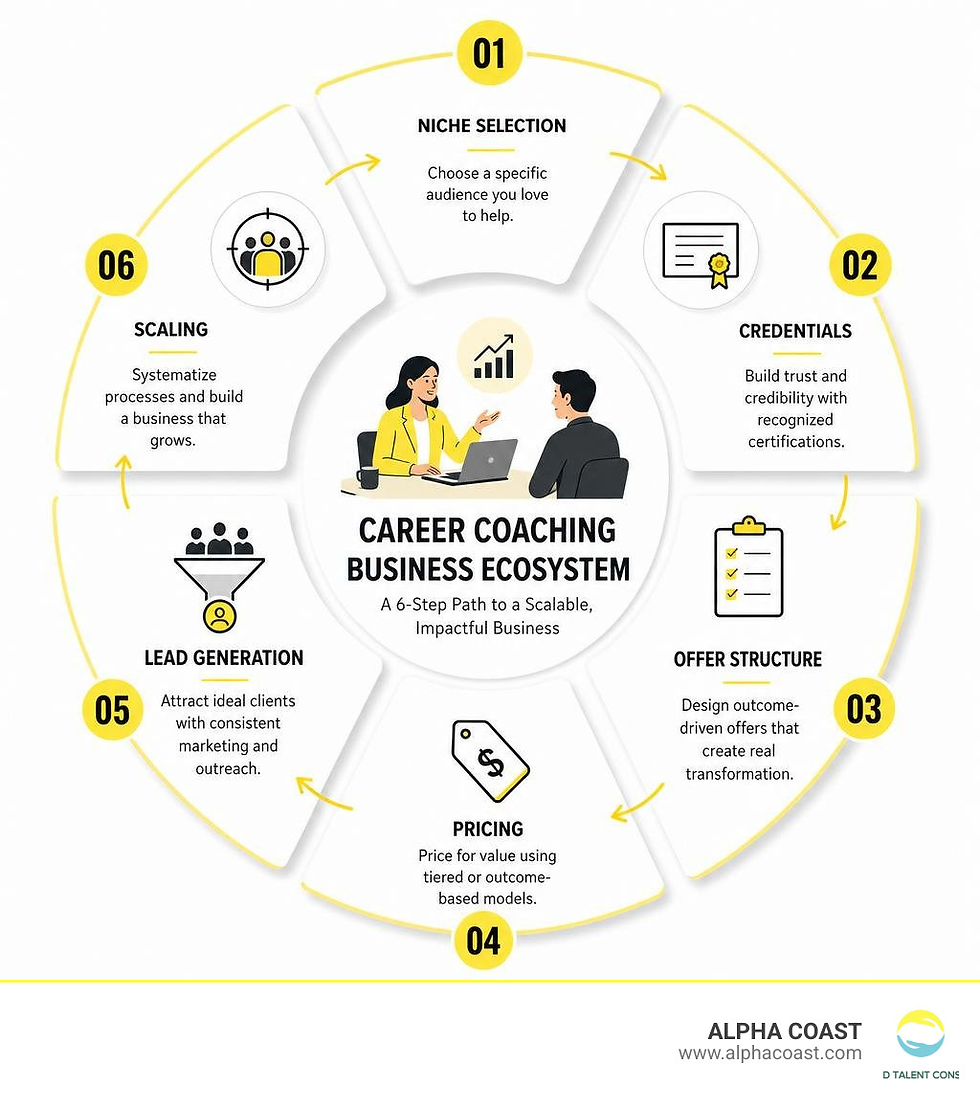
How to start a career coaching business (quick overview):
Pick a niche — executive coaching, career changers, Millennials, or industry-specific clients
Get credentialed — ICF certification increases client trust and satisfaction rates significantly
Build your offer — sell outcomes and transformations, not hours or sessions
Set up client acquisition — LinkedIn, outbound outreach, lead magnets, and referral systems
Price for value — use tiered packages or outcome-based models, not hourly rates
Systematize lead generation — move from inconsistent referrals to a predictable pipeline
The global coaching industry was valued at $4.56 billion in 2023 and is projected to grow at 6.7% annually through 2032. Demand is real. With 47% of Millennials wishing they had chosen a different career path, and 46% planning to job hunt in the next 12 months, the market of people who need help navigating their careers has never been larger.
But here is the uncomfortable truth: most career coaches are great at coaching and terrible at building a business. They land a few clients through referrals, plateau, and then wonder why their revenue is unpredictable month after month.
This guide covers everything — from defining your niche and structuring your services, to marketing, scaling, and building the kind of client pipeline that does not depend on luck.
I am Kent Vanho, founder of Alpha Coast, a client-acquisition firm that has helped 400+ career coaching business owners build predictable inbound pipelines using done-for-you systems rather than guesswork. Over the past several years, I have worked closely with coaches at every stage — from first client to seven figures — and I have seen what separates the ones who thrive from the ones who stall.
Defining Career Coaching vs. Mentoring and Consulting

To build a highly profitable career coaching business, we must first define what we actually do—and what we do not do. Too many professionals enter this space and call themselves "coaches" when they are actually acting as consultants or mentors. This confusion muddies their marketing, dilutes their value proposition, and makes it incredibly difficult to charge premium prices.
Let us break down the differences:
Coaching is a collaborative, thought-provoking partnership. As coaches, we do not hand our clients a list of answers. Instead, we use active listening, emotional intelligence, and critical thinking to empower them to discover their own solutions. We provide the structure, accountability, and guidance, but the client drives the transformation.
Mentoring is a relationship based on shared experience. A mentor is someone who has already walked the path and says, "Here is how I did it; you should do the same." While valuable, mentoring is typically informal and advice-driven.
Consulting is purely diagnostic and solution-focused. A consultant analyzes a problem, writes a prescription, and sometimes even builds the deliverables (like writing a resume from scratch without the client's input).
Feature | Coaching | Mentoring | Consulting |
Primary Role | Facilitator & Partner | Advisor & Guide | Expert & Problem Solver |
Source of Answers | Drawn from the client | Based on mentor's past experience | Provided by the consultant |
Focus | Personal & professional growth | Career path guidance | Specific project or technical issue |
Approach | Asking powerful questions | Sharing personal stories & advice | Providing direct solutions & plans |
By establishing these boundaries early, we can position our services around high-value transformation rather than transactional tasks.
Why Professionals Seek Coaching Services
Why do clients pay thousands of dollars to work with a career coach? It rarely boils down to "needing a better resume." In our experience, clients are running away from pain or running toward a massive opportunity.
The most common catalysts include:
The "Sunday Scaries" and Burnout: Millions of mid-career professionals experience a deep sense of dread every Sunday evening. They feel stuck in unfulfilling roles and are desperate for a career pivot but lack the confidence to make the leap.
Millennial Career Dissatisfaction: Millennials make up a massive portion of the workforce, and 47% of them wish they had chosen a different career path. Furthermore, 46% plan to actively job hunt over the next 12 months, primarily chasing higher salaries and better work-life balance.
The Need for Executive Positioning: Senior leaders often have impressive histories but terrible narratives. They struggle to articulate their "superpowers" to board members or hiring committees. They do not need resume polishers; they need executive storytelling.
The Pursuit of Tangible ROI: Ambitious professionals want measurable career advancement. They seek coaching to secure 15% to 30% salary increases, negotiate better executive compensation packages, or land promotions that have eluded them for years.
To see how top-tier professionals structure their breakthrough programs to address these exact pain points, look at Kathy Caprino's Career Coaching, which focuses on helping leaders advance, thrive, and build authentic influence.
Essential Skills and Qualifications for Coaches
If you want to run a thriving career coaching business, your corporate background is a great asset, but it is not the whole story. The best coaches possess a unique blend of soft skills and business acumen:
Empathy and Active Listening: You must be able to hear what your client isn't saying. Understanding their underlying anxieties, imposter syndrome, and limiting beliefs is key to unlocking their potential.
Critical Thinking and Problem Solving: You need to help clients dissect complex career dilemmas, evaluate market opportunities, and map out structured, actionable roadmaps.
Business Acumen: You are not just a coach; you are a business owner. You must understand how companies hire, how executive decisions are made, and how to market your own services.
Many successful coaches pivot from careers in human resources or recruiting because they already understand the "behind-the-scenes" mechanics of corporate hiring. For example, Lauren Lustig Advisors leverages over 20 years of HR-related experience to offer high-impact career coaching and corporate training, giving clients a distinct competitive edge.
The Impact of Credentials on Client Acquisition
Can you start a career coaching business without a certification? Technically, yes. The coaching industry is currently unregulated. However, building a sustainable business without credentials in 2026 is uphill sledding.
Consider these industry statistics:
80% of coaches agree that modern clients expect their coach to hold a formal credential or certification.
92% of coaching clients whose coaches held a credential reported being highly satisfied with their coaching experience.
Earning a credential from a recognized body like the International Coaching Federation (ICF) does more than teach you how to coach. It gives you instant credibility in a crowded market. When corporate clients or high-paying executives look to hire a coach, an ICF credential acts as a vital trust signal. It proves you adhere to strict ethical guidelines and have undergone rigorous, supervised training.
To understand how credibility directly feeds into your marketing and lead generation, check out our Ultimate Client Acquisition Guide 2026.
Key Components of a Successful Career Coaching Business
Building a successful business model requires shifting your mindset from "selling coaching sessions" to "selling transformations."
The most common trap new coaches fall into is what we call the "Broke Coach" model. They build a beautiful website, create profiles on every social media platform, offer generic "career advice," and sell single 60-minute sessions for $100. They spend 30 hours a week tweaking their website and zero hours talking to actual prospects.
A successful business model rests on three pillars:
A Highly Defined Target Market: You cannot be everything to everyone. Trying to coach college grads, corporate VPs, and retiring teachers all at once means your message resonates with no one.
A Proprietary Process: You need a signature framework (e.g., a 3-step or 4-stage system) that takes clients from confusion to their desired outcome. This framework is your intellectual property and your main differentiator.
An Inbound Client Acquisition System: You need a predictable, automated way to attract, qualify, and book discovery calls with high-intent buyers so you do not spend your life sending cold DMs or posting endless social media content.
Profitable Niches for Your Career Coaching Business
The riches are truly in the niches. When you specialize, your marketing becomes incredibly simple because you are speaking directly to a specific person's exact pain points.
Here are some of the most profitable niches in the career coaching space:
Executive Career Coaching: Helping Directors, VPs, and C-suite executives navigate transitions, refine their leadership narratives, or onboard into new high-pressure roles. This niche commands the highest premium fees.
Mid-Career Pivots: Guiding professionals in their late 20s and 30s (especially Millennials) who are burned out and want to transition into entirely new industries without starting at the bottom of the corporate ladder.
Industry-Specific Coaching: Specializing in tech, finance, healthcare, or creative industries. For example, coaching software engineers on how to pass system design interviews or helping product managers land six-figure roles.
Clarity and Alignment Coaching: Using industrial-organizational psychology principles to help ambitious professionals break free from career confusion and build paths aligned with their core values.
Structuring Services and Pricing Models
Stop selling your time by the hour. When you charge an hourly rate, you create a conflict of interest: the faster and more effective you are at helping your client get results, the less money you make.
Instead, structure your services around high-value packages:
Tiered Packages (Done-With-You / Done-For-You): Offer structured 3-month or 6-month programs. A typical mid-career transition package might include 12 weekly sessions, resume rewrite support, LinkedIn optimization, and mock interview prep. These packages easily command $2,000 to $5,000+.
Retainer Models: For executive clients or ongoing leadership support, charge a monthly retainer (e.g., $1,000/month) for a set number of monthly calls and unlimited email/Slack support.
Outcome-Based Pricing: Align your pricing with the financial transformation you deliver. If your coaching helps an executive secure a $50,000 salary increase, charging a premium flat fee of $5,000 is an easy sell.
Marketing and Client Acquisition Strategies

You can be the most brilliant career coach on the planet, but if no one knows you exist, your business will fail. To get clients consistently, you must master the art of intentional marketing.
The foundation of modern career coach marketing is LinkedIn optimization. Your ideal clients—professionals who have the disposable income to invest in coaching—are active on LinkedIn.
To turn your profile into a client-attracting landing page:
Write a Client-Centric Headline: Do not just write "Executive Career Coach." Write: "I help mid-career corporate leaders pivot into tech roles and secure $30k+ salary increases."
Tell Your Origin Story in the About Section: Explain why you became a coach. Share your own career breakthrough or burnout story. This builds immediate empathy and rapport.
Use a Clear Call to Action (CTA): Direct profile visitors to a free resource (a lead magnet) or invite them to book a complimentary strategy call.
To learn more about setting up your marketing foundations, read our guides on How to Get Coaching Clients and Career Coach Marketing.
Balancing Client Work and Business Development
The biggest operational challenge for solo coaches is the "revenue rollercoaster."
You market heavily, book five new clients, and then stop marketing because your calendar is full. Three months later, those clients graduate, and you suddenly realize your pipeline is empty. You are back to square one, panicking and scrambling for leads.
To break this cycle, you must treat business development as a non-negotiable daily activity, even when you are fully booked.
We recommend dedicating at least 20% of your week to client acquisition. This includes:
Engaging with high-intent prospects on LinkedIn.
Nurturing your email list with valuable, actionable career tips.
Optimizing your inbound lead generation systems.
If you want to build a highly predictable pipeline without spending hours sending manual messages, read our insights on Business Development Guide Career Coaches and discover How Do Career Coaches Get Clients Consistently.
Overcoming Common Challenges and Ethical Standards
Building a sustainable business requires navigating several common roadblocks:
The "Broke Coach" Trap: Giving away too much free advice in discovery calls or undercharging because of imposter syndrome. Remember: clients do not value what they do not pay for.
Burnout: Trying to manage 25 active 1-on-1 clients simultaneously while handling your own marketing, admin, and bookkeeping.
Scope Creep: Allowing clients to text you at 10 PM on a Sunday or expecting you to act as a therapist.
Setting firm professional boundaries from day one is essential. Your client agreement should clearly outline session cancellation policies, communication boundaries, and payment terms.
Ethics and Professional Standards in Coaching
As career coaches, we deal with sensitive personal data, corporate secrets, and deep psychological vulnerabilities. Adhering to strict professional standards is paramount:
Confidentiality: Everything discussed in your sessions must remain strictly confidential. This is especially vital if you are coaching multiple executives within the same industry or organization.
Role Boundaries: Recognize when a client's challenges exceed your scope of practice. If a client is dealing with severe clinical anxiety, depression, or deep-seated trauma, you must ethically refer them to a licensed therapist.
Honesty in Marketing: Do not promise guaranteed job placements or specific salary figures. Frame your outcomes around what you can control: providing the strategy, tools, and support necessary for the client to achieve their goals.
Scaling and Reshaping Your Career Coaching Business
Once your 1-on-1 roster is full and you are consistently hitting your revenue targets, it is time to think about scaling. You cannot scale a business if your revenue is strictly tied to the hours you spend sitting in front of a webcam.
The modern career coaching landscape has been completely reshaped by technology:
Virtual Coaching: You are no longer limited to clients in your local city. You can coach professionals globally using video conferencing, digital scheduling tools, and asynchronous messaging platforms.
AI Integration: Successful coaches are leveraging generative AI tools to streamline administrative tasks, draft resume templates, and run mock interview simulations, freeing up hours of manual work every week.
Scaling Your Career Coaching Business Beyond 1-on-1
To scale your revenue without working more hours, consider transitioning to one of these leveraged models:
Group Coaching Programs: Instead of coaching ten clients individually for one hour each, bring them together into a structured weekly group coaching session. This model creates a powerful sense of community, peer accountability, and allows you to serve more people in less time.
Hybrid Online Courses: Package your core teaching (e.g., how to build a personal brand, optimize a LinkedIn profile, or negotiate an executive salary) into self-paced video modules. Your coaching then focuses purely on high-level strategy and personalized feedback during live Q&A sessions.
Corporate and Group Workshops: Transition from B2C to B2B by selling career development workshops directly to organizations looking to improve employee retention and engagement.
For a deep dive into expanding your reach, explore our resources on how to Grow Coaching Practice and access our Ultimate Guide Get More Coaching Clients.
Measuring and Demonstrating Coaching ROI
To charge premium prices, you must be able to prove the return on investment (ROI) of your services. Career coaching is unique because its financial ROI is highly quantifiable.
We recommend tracking these key metrics with your clients:
Compensation Increases: Document the average salary jump your clients secure. If your average client lands a 25% raise, showcase that statistic proudly in your marketing.
Time-to-Placement: Track how quickly your clients land roles compared to the industry average. If the average job search takes six months, and your coached clients land roles in 60 days, that is a massive selling point.
Promotion Rates: Monitor how many of your leadership clients secure promotions within 12 months of finishing your program.
Qualitative Impact: Collect written and video testimonials highlighting improved work-life balance, reduced anxiety, and boosted professional confidence.
Frequently Asked Questions about Career Coaching
Do I need a certification to start a career coaching business?
Technically, no legal certification is required to call yourself a career coach in 2026. However, holding a credential from a recognized body like the ICF vastly improves your credibility, makes client acquisition easier, and ensures you can charge premium prices. 80% of coaches agree that clients expect their coach to be credentialed.
How much do career coaches charge?
Pricing varies wildly based on niche and experience. Beginner coaches often charge $100 to $150 per hour. However, established coaches selling outcome-based packages typically charge between $2,000 and $5,000 for a 3-month program. Executive coaches working with C-suite clients can easily command $10,000+ per engagement.
How do career coaches find their first clients?
Most new coaches find their first 2 to 3 clients through their immediate professional network, LinkedIn profile optimization, and by offering high-value "clarity sessions" or lead magnets to build trust. To build a highly predictable, repeatable system for booking high-intent client calls, read our More Coaching Clients Tips 2026.
Conclusion
Starting and growing a career coaching business is incredibly fulfilling, but navigating the business development side can feel like a full-time job in itself. If you spend all your time chasing leads, tweaking your website, and sending manual LinkedIn messages, you have less time to do what you actually love: coaching your clients and changing lives.
That is where we come in.
At Alpha Coast, we offer white-glove, done-for-you business development and lead generation designed specifically for career and executive coaches. Our proprietary Client Accelerator system is built to predictably acquire only the top 3% "ready-to-buy" clients in your target niche. We handle the positioning, the outreach, and the lead nurturing, delivering highly qualified, high-intent prospects straight to your calendar.
Stop riding the revenue rollercoaster and let us build a predictable client pipeline for your business.


Comments