

From Zero to Hero: Crafting Your Client Acquisition Masterplan

Why Every Coach Needs a Client Acquisition Blueprint to Grow Predictably

A client acquisition blueprint is a step-by-step system that takes a potential client from never having heard of you to signing a contract — repeatedly and predictably.
Here is what a solid blueprint covers:
Define your ideal client — who they are, what they need, and where to find them
Choose your acquisition channels — cold outreach, warm outreach, free content, or paid ads
Build your funnel — move prospects from awareness to trust to a buying decision
Optimize and measure — track cost per acquisition (CPA), conversion rates, and lifetime value (LTV)
Scale with systems — use automation and repeatable processes so growth is not dependent on luck
If you are a coach, you already know the problem. One month your calendar is full. The next, it is empty. That feast-or-famine cycle is not a talent problem. It is a systems problem.
And the environment is getting harder. Research from HubSpot shows that 55% of consumers no longer trust the brands they buy from as much as they used to, 69% do not trust advertising, and 71% distrust sponsored social media posts. Pushing your services louder is not the answer. Building a system that attracts the right clients is.
That is exactly what a client acquisition blueprint solves. Instead of guessing, you follow a proven sequence. Instead of chasing leads, you create conditions where the right clients come to you — or are ready to say yes when you reach out.
I'm Kent Vanho, founder of Alpha Coast, and I have spent the last several years helping 400+ coaches and consultants replace inconsistent referrals with a reliable, systemized client acquisition blueprint built around their strengths and audience. In this guide, I'll walk you through the exact framework we use.
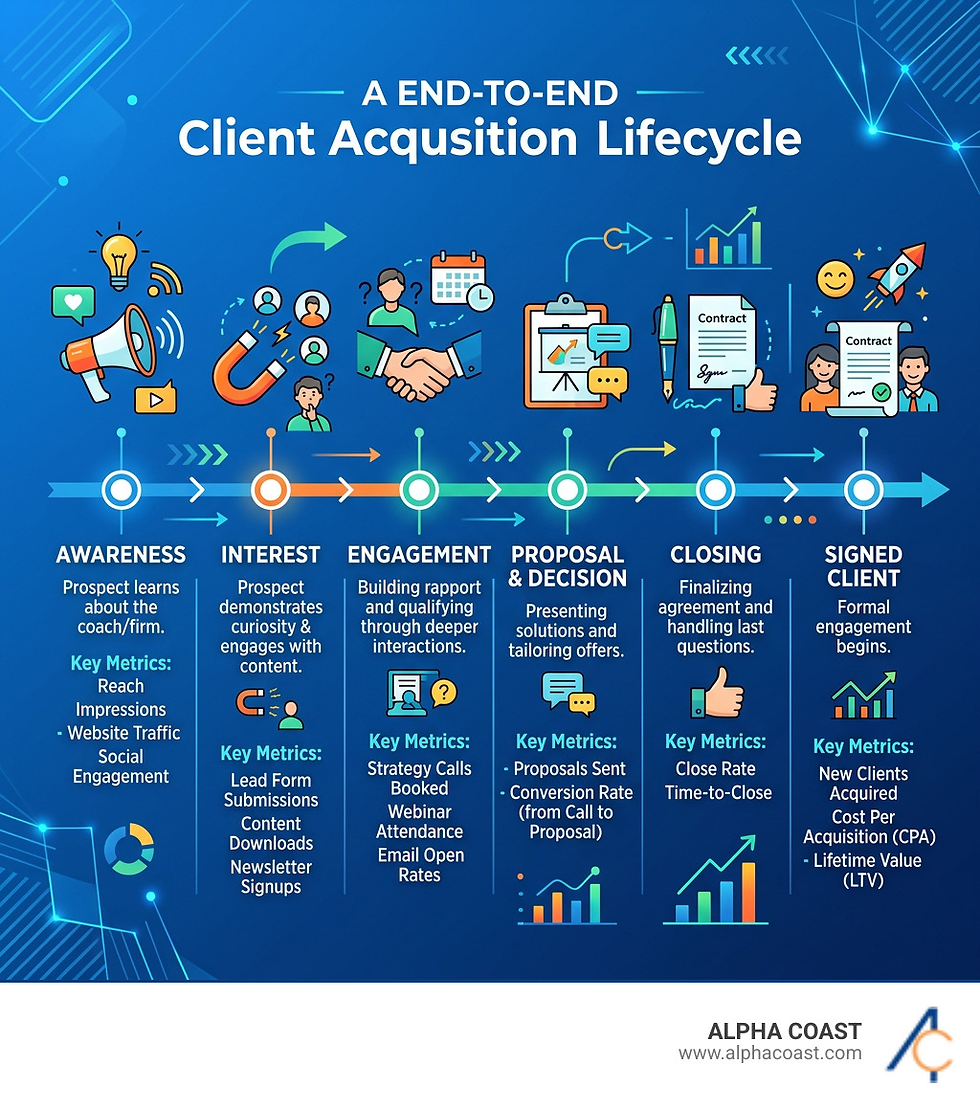
What is a Client Acquisition Blueprint and Why You Need One
Many coaches confuse lead generation with client acquisition. Lead generation is simply the act of getting someone to raise their hand. A client acquisition blueprint, however, is an end-to-end journey. It encompasses everything from the first moment of awareness to the final signature on a coaching agreement.
As we mentioned, consumer trust is at an all-time low. According to HubSpot research on declining consumer trust in advertising, people are increasingly skeptical of "push" marketing—those loud, interruptive ads that flood social feeds. This is why a blueprint is essential; it shifts your strategy toward "pull" marketing. Instead of chasing, you provide value that builds authority and trust before you ever ask for a sale.
Without a blueprint, your business is not scalable. You are likely relying on "hope marketing"—hoping the phone rings or hoping a past client remembers to mention you. A structured plan provides:
Predictable Revenue: You know that if you put $X into the system or send Y number of messages, you will likely yield Z number of clients.
Scalability: You can increase your efforts without increasing your stress because the process is documented and repeatable.
Focus: It allows you to engage in Business Development Coaching with a clear roadmap rather than throwing spaghetti at the wall.
The 4 Pillars of an Effective Client Acquisition Blueprint
To build a sustainable practice, we recommend a multi-channel strategy. Relying on just one source of clients is risky. If that channel changes its algorithm or becomes too expensive, your business stalls. Instead, we look at four proven methods, each with its own role in your client acquisition blueprint.
Method | Pros | Cons |
Cold Outreach | Highly scalable, targeted, and controlled. | Requires persistence and technical setup. |
Warm Outreach | Fastest way to get clients; high trust. | Limited by the size of your current network. |
Free Content | Builds long-term authority and "pull." | Takes time to see compounding results. |
Paid Ads | Fast and measurable results. | Can be expensive if not managed correctly. |
By balancing these pillars, you create a marketing ecosystem that works while you sleep. You aren't just looking for any lead; you are looking to Attract High Paying Clients who value your expertise.

Mastering Cold Outreach within your Client Acquisition Blueprint
Cold outreach often gets a bad reputation because most people do it poorly. They send "spammy" messages to everyone with a pulse. In a professional client acquisition blueprint, cold outreach is surgical.
It starts with your digital storefront. For most executive and career coaches, that is LinkedIn. If your profile reads like a CV (a list of past jobs), you are killing your conversion rate before you even send a message. You must use a LinkedIn Profile Optimiser approach to turn your profile into a buyer-facing landing page. It should focus on the outcomes you provide, not just your credentials.
Once your profile is optimized, you can leverage sales automation to scale. However, the key is personalization. We have seen connection acceptance rates climb above 50% and reply rates hit one in four when messages are tailored to the recipient's specific pain points. This is how you generate high-quality Business Coach Leads consistently.
Leveraging Referrals to Scale your Client Acquisition Blueprint
Referrals are the "holy grail" of coaching because they come with a built-in trust proxy. You aren't starting from zero; the referrer has already done the heavy lifting of establishing your credibility.
Research shows that referred leads close 69% faster than non-referred leads. Yet, most coaches treat referrals as a happy accident. To Grow Coaching Practice sustainably, you must turn referrals into a predictable engine.
We recommend "Quarterly Referral Sprints." Instead of waiting for clients to remember you, reach out to your top 20–50 happiest clients every three months. Summarize the value you’ve provided and ask specifically for introductions to peers who might be facing similar challenges. When you add a clear incentive structure—whether that’s a referral fee or a gift—you normalize the process of being championed by your network.
Defining Your Ideal Client and Core Value Proposition
You cannot be everything to everyone. If you try to coach "anyone who wants to be better," you will struggle to acquire clients because your message is too diluted. To win, you must niche down.
Creating a detailed customer persona is the foundation of your client acquisition blueprint. You need to know:
Demographics: Job title, industry, and income level.
Pain Points: What keeps them awake at 2 AM? Is it a lack of executive presence? Career stagnation? Team conflict?
Desired Outcomes: What does "winning" look like for them in 6 months?
When you target High Ticket Clients, your offer must be "irresistible." This means moving away from selling "sessions" and toward selling "solutions." A CEO doesn't want to buy "12 hours of coaching"; they want to buy "A 90-day plan to transition into a global leadership role."
Measuring Success: Key Metrics and Optimization
If you don't measure it, you can't improve it. Many businesses fail because they focus on "vanity metrics" like likes or followers instead of the numbers that actually drive growth. In your client acquisition blueprint, focus on these four:
CPA (Cost Per Acquisition): How much does it cost you in ad spend or time to get one new paying client? For example, a cybersecurity firm might spend $5,500 to acquire a $57,000 client—a very healthy ratio.
ROAS (Return on Ad Spend): If you use paid ads, how much revenue do you generate for every dollar spent? We’ve seen cases where a $15,000 investment turned into over $320,000 in sales.
LTV/CAC Ratio: Your Lifetime Value (LTV) should be at least 3x your Customer Acquisition Cost (CAC). If it costs you $1,000 to get a client, they should bring in at least $3,000 over their time with you.
Conversion Rate: Are your landing pages working? For Lead Generation for Business Coaches, a visitor-to-lead conversion rate of 1% to 3% is a good benchmark to aim for.
Optimizing your sales process is just as important as getting leads. Use A/B testing on your landing page copy, simplify your contact forms, and ensure your call-to-action (CTA) is clear and urgent.
Your 90-Day Playbook for Implementation
Building a client acquisition blueprint isn't an overnight task, but you can see significant results in 90 days if you follow a structured plan.
Phase 1: Days 1–30 (Infrastructure & Setup)
Define your niche and core offer.
Fix your LinkedIn profile using the LinkedIn Profile Optimiser strategy.
Set up your technical infrastructure (email subdomains, CRM, and tracking).
Phase 2: Days 31–60 (Content & Outreach)
Start your first cold outreach sequence (aim for 20–50 high-quality touches per day).
Begin posting "authority content" that answers your ideal client's top three questions.
Run your first Referral Sprint.
Phase 3: Days 61–90 (Distribution & Scaling)
Analyze which channels are providing the highest quality leads.
If your organic funnel is converting, consider layering on $1,000/month in paid ads to accelerate.
Optimize your sales script based on the objections you’ve heard in the last 60 days.
By following this timeline, you move toward Coaching Business Success with data on your side rather than just intuition.
Frequently Asked Questions about Client Acquisition
How long does it take to see results from a new blueprint?
It depends on the channel. Paid ads and warm outreach can generate meetings within days. Cold outreach typically takes 2–4 weeks to "warm up" and start producing consistent calls. Organic content and SEO are long-term plays that usually start compounding after 3–6 months. The goal is to use the fast channels to fund the long-term ones.
Should I focus on organic or paid acquisition first?
We usually recommend starting with "organic" methods like cold outreach and content first. Why? Because it allows you to test your messaging for free. If you can't get someone to reply to a personalized message, spending $5,000 on ads won't fix the problem—it will just make the problem more expensive. Once you have a message that converts, use paid ads to scale it.
How do I find a niche as an executive coach?
Look for the intersection of three things: what you are world-class at, what you enjoy doing, and what the market is willing to pay a premium for. Often, this involves vertical selection—specializing in a specific industry like "IT Managed Services" or "Family Law." When you speak the specific language of an industry, your value proposition becomes much stronger.
Conclusion
Building a client acquisition blueprint is the difference between having a hobby and having a high-growth business. It removes the anxiety of not knowing where your next client is coming from and replaces it with a system you can control.
At Alpha Coast, we understand that as a high-level coach, your time is best spent coaching, not chasing leads. That is why we developed our "Client Accelerator" system. We provide white-glove, done-for-you business development that predictably acquires only the top 3% of "ready-to-buy" clients for career and executive coaches.
We handle the technical setup, the outreach, and the lead nurturing, so you only show up to speak with qualified prospects who are already pre-sold on your value. If you are ready to stop the feast-or-famine cycle and start scaling with a professional system, we are here to help.
To learn more about how we can build your custom acquisition engine, visit us at https://www.alphacoast.com.



Comments