

How to generate leads for coaching without losing your mind

Why Most Coaches Struggle to Get Consistent Coaching Leads

Coaching leads are potential clients who have shown interest in working with a coach — and getting them consistently is the number one challenge for most coaching businesses.
Here's a quick answer to how coaches generate leads reliably:
Free (Organic) — Content marketing, SEO blogging, LinkedIn, podcasts
Paid — Facebook, Google, or LinkedIn ads driving traffic to a landing page
Partnership — Joint ventures, referrals, and guest workshops with others who already reach your ideal clients
The fastest path to a full calendar is picking one of these three and executing it well — not all three at once.
Most career and executive coaches are skilled at the work itself. But filling a pipeline? That's a completely different skill set.
The coaching industry has grown fast. There are now roughly 145,500 active coaches worldwide — more than double the number from 2019. More coaches means more competition, and the days of growing a full practice on word-of-mouth alone are fading.
The result? A lot of coaches are stuck in a feast-or-famine cycle. Clients come in through referrals, then dry up. A new strategy gets tested, burns time and money, then gets abandoned. Revenue swings wildly from month to month.
The problem usually isn't the coaching. It's the absence of a system.
I'm Kent Vanho, founder of Alpha Coast, where I've helped 400+ career and executive coaches build predictable, inbound pipelines for coaching leads using done-for-you acquisition systems. In this guide, I'll show you exactly what works — and what to skip.

The Only 3 Proven Ways to Generate Coaching Leads
If you look at the most successful coaches in the world in April 2026, you’ll notice they don’t try to do everything. They don't have "hundreds" of marketing strategies. According to industry experts, there are only three proven ways to generate coaching leads, and mastering just one is usually enough to build a multi-six-figure practice.

1. Free (Authority Marketing)
This is about building a presence where your ideal clients already hang out. It includes SEO blogging, posting on social media, and guesting on podcasts. While it’s called "free," it actually costs a significant amount of time. The goal here is to build such high authority that people seek you out.
2. Paid Traffic
If you have more cash than time, paid traffic is the fastest route. This involves running ads on platforms like Google, LinkedIn, or Facebook. According to the ICF Global Coaching Study, the coaching industry reached a staggering $6.25 billion in 2024, and much of that growth is fueled by coaches who treat their marketing like a science. Paid ads allow you to scale quickly, provided you have a high-converting landing page.
3. Partnership Marketing
This is the "who you know" strategy. It involves joint ventures, guest workshops for other people's audiences, and referral networks. If you are a natural networker, this is often the most enjoyable way to get coaching leads. You leverage the trust someone else has already built with their audience.
Understanding What is Client Acquisition is the first step toward moving away from "random acts of marketing" and toward a predictable business model.
Choosing your primary traffic source
The biggest mistake we see coaches make is trying to be everywhere at once. To truly scale, you need to follow the F.O.C.U.S. principle: Follow One Course Until Successful.
Successful coaches generate 90% of their revenue from a single primary source. For the next year, we recommend you commit to:
One target market: Stop trying to coach "everyone with a problem."
One product: Perfect your flagship coaching program.
One conversion tool: Use one method (like a discovery call or a webinar) to close deals.
One traffic source: Master LinkedIn, or master Google Ads, but don't try to master both simultaneously.
Leveraging Marketplaces and Directory Platforms
Not every coach wants to be a "content creator." If the idea of writing daily blog posts makes you want to hide under your desk, directory platforms can be a godsend. These sites allow you to tap into existing traffic from people who are already actively looking for a coach.
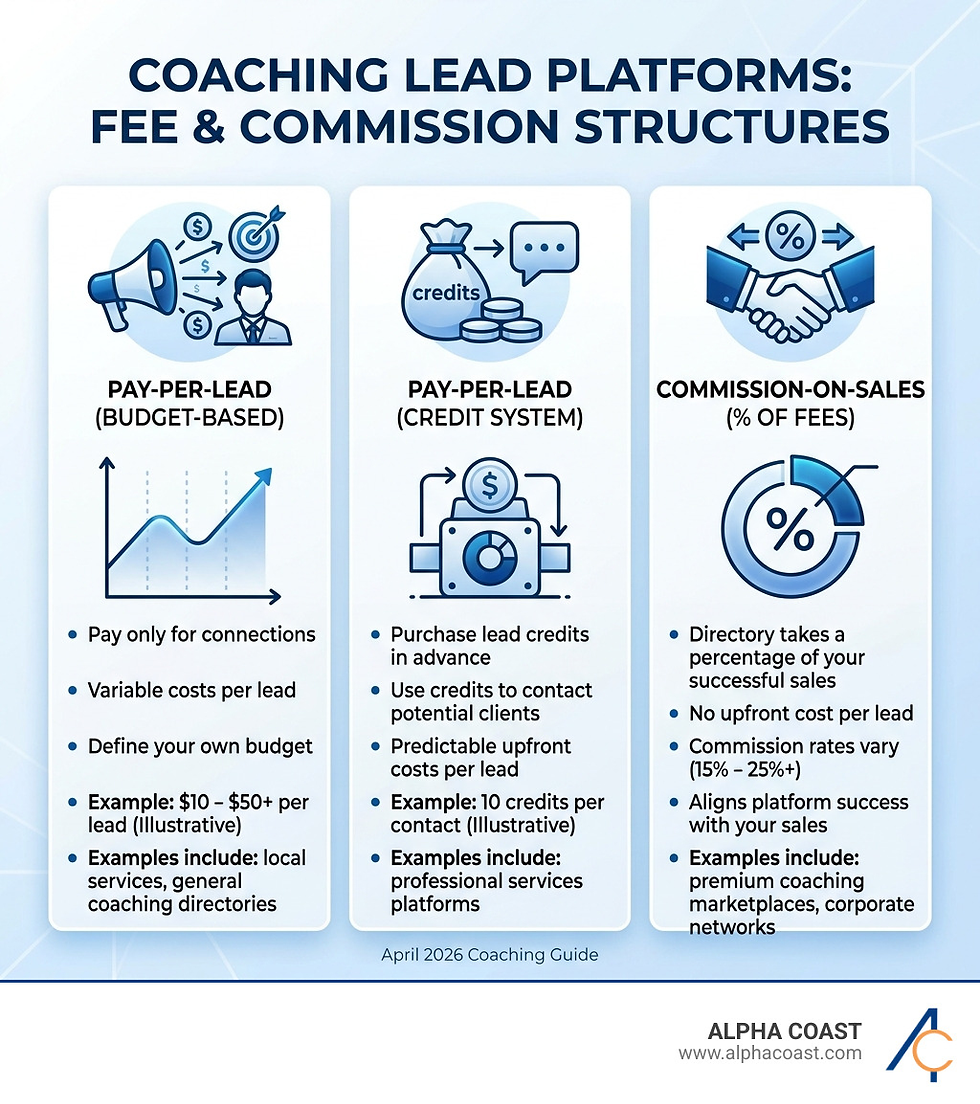
Platform | Fee Structure | Best For |
Thumbtack | Pay-per-lead (variable budget) | Local and general life coaching |
Bark | Pay-per-lead (uses "credits") | Broad range of coaching services |
15% - 25% commission on sales | Executive and professional coaches | |
Noomii | Annual membership fee | Coaches wanting a fixed-cost directory |
LinkedIn Services | Free (replaces ProFinder) | B2B and career coaching |
LifeCoachHub | Monthly subscription (starts ~$17) | Life coaches building a profile |
Directories provide Professional Lead Generation opportunities without the need for a complex website. However, because these platforms are competitive, you cannot just "set it and forget it." You need to actively manage your presence to get high-quality Business Coach Leads.
Maximizing conversion on third-party sites
To win on platforms like Bark or Thumbtack, you have to be fast. Data shows that responses sent within the first 3 hours are significantly more likely to convert into paying clients. If you wait 24 hours, the lead has likely already moved on to a competitor.
Other key tactics include:
Video Introductions: Profiles with video get more engagement because coaching is a relationship-based business. Let them hear your voice.
Client Reviews: Request reviews immediately after a successful session. Don't wait three months; the "glow" of the transformation will have faded.
Niche Tailoring: Don't list 50 different specialties. If you are an executive coach, make your profile scream "Executive Excellence."
Mastering LinkedIn for Organic Growth
For career and executive coaches, LinkedIn is the undisputed heavyweight champion of High Ticket Clients. With over 800 million members, it is the place where decision-makers and high-earning professionals congregate.

Unlike Instagram, where the algorithm rewards "viral" trends, LinkedIn rewards authority and relationship psychology. You don't need 100,000 followers to get coaching leads; you just need the right 100 connections.
High-Quality Coaching Leads on LinkedIn
We often recommend a strategy called the Six Circles. Start by mapping your existing network. Your first high-value client is almost always someone you already know or someone one degree away from you.
Instead of cold DMs—which most people find "sleazy"—focus on permission-based marketing. This means using "DM Magnets." For example, post a helpful checklist and ask people to comment "Ready" if they want a copy. When they comment, you have permission to start a conversation in the DMs without it feeling like a cold pitch. This is a core part of effective Lead Generation for Business Coaches.
The 1-hour daily lead routine
You don't need to spend all day on LinkedIn. A disciplined 60-minute routine is more effective than six hours of aimless scrolling:
15 Minutes: Connection Requests: Send 10–20 personalized requests to your ideal client profile (ICP). Mention a specific piece of their work or a shared interest.
20 Minutes: Content Creation: Use a "Content Ladder" approach. Share a story that illustrates a transformation, or use the "priming effect" by teaching a small concept that makes them realize they need your bigger coaching offer.
15 Minutes: Engagement: Comment on the posts of your ideal clients. Be helpful, not salesy.
10 Minutes: Follow-ups: Check your DMs and reconnect with people who engaged with your previous posts.
Sustainable Systems and Content Marketing
If you want your business to be around in 2030, you need a system that doesn't rely on you "hustling" every single day. This is where content marketing comes in. When done right, your content works for you while you sleep, attracting coaching leads into your ecosystem.
Scaling with Sustainable Coaching Leads
The secret to content marketing isn't volume; it's relevance.
SEO Blogging: Writing about the specific problems your clients face (e.g., "how to handle executive burnout") brings in search traffic from Google.
Podcast Guesting: Being a guest on established shows is a high-leverage way to build trust quickly. You are borrowing the host's authority.
Lead Magnets: Offer a high-value PDF or video training in exchange for an email address. This allows you to nurture leads over time.
Case Studies: Nothing sells coaching better than proof. Documenting a client's journey from "Stuck" to "Success" is the ultimate trust-builder.
For a deeper dive into these long-term strategies, check out our Ultimate Guide Get More Coaching Clients or our tactical breakdown on How to Get Coaching Clients.
Turning past clients into lead machines
Your best source of new coaching leads is your past clients. They have already experienced your value and are your best advocates.
Referral Incentives: Offer a "referral thank you" (like a free strategy session or a gift) for any client they send your way.
Success Documentation: Ask clients for video testimonials. Seeing a real person talk about their results is worth more than any sales copy you could write.
Networking Groups: Join high-level masterminds or networking groups where your past clients hang out. Staying "top of mind" ensures that when someone asks them for a coach recommendation, your name is the first one mentioned.
Avoiding Pitfalls and Choosing Your Strategy
Many coaches fail because they fall for "shiny object syndrome." They see someone making millions on TikTok and think they need to be there, too. This leads to burnout and a lack of results. Understanding Why Coaches Struggle to Get Clients is essential to avoiding these traps.
Money makers vs. waste of time
Based on real-world experiments from hundreds of coaches, here is the breakdown of what actually moves the needle:
The Money Makers:
Email Marketing: Your list is your most valuable asset.
Paid Events: People who pay for a small workshop are 10x more likely to buy high-ticket coaching.
Case Studies: Real proof converts "tire kickers" into buyers.
SEO Blogging: Long-term, sustainable traffic that you own.
The Potential Waste of Time:
Cold Outreach: Unless you are a sales expert, cold calling/emailing often yields very low ROI and high frustration.
Free Events: These often attract "freebie seekers" who have no intention of investing in high-ticket coaching.
Buying Leads: Services that sell you "lists" of names are often a gamble. Many of these leads are cold, unresponsive, or have been sold to 50 other coaches.
Business Cards and PR: Being featured in a major magazine feels good for the ego, but it rarely results in immediate Attract High Paying Clients results.
If you are struggling to manage the "outreach" part of your business, you might consider Appointment Setters for Coaches, but be wary of low-cost VAs who don't understand your brand's voice.
Frequently Asked Questions about Coaching Leads
What is the fastest way to get coaching leads in 2026?
The fastest way is Paid Ads (Google or Meta) driving traffic to a high-value lead magnet or a direct discovery call booking page. If you have a budget of $500–$1,000 per month, you can start seeing leads within 48 hours. However, this requires a "proven offer" that you know people want.
Should I buy coaching leads from third-party services?
Proceed with caution. While some services like CoachingLeads provide pre-verified leads from active social media profiles (often 2,000+ leads per month for around $97), these are still outbound leads. This means you still have to do the work of reaching out and "selling" them. If you hate sales calls, buying leads won't solve your problem.
How much should I budget for coaching lead generation?
For organic strategies, your "budget" is your time (usually 10–15 hours a week). For paid strategies, expect a Cost Per Lead (CPL) of anywhere from $5 to $50 depending on your niche. Executive coaching leads are more expensive than general life coaching leads because the lifetime value of the client is much higher.
Conclusion
Generating coaching leads doesn't have to be a source of constant stress. The secret is to stop chasing every new trend and start building a scalable system. Whether you choose to master LinkedIn, dominate a directory marketplace, or invest in paid traffic, the key is consistency and focus.
In 2026, the coaches who thrive are the ones who treat their lead generation as a professional business process, not a hobby. By qualifying your leads early and focusing on "ready-to-buy" prospects, you can spend less time marketing and more time doing what you love: coaching.
At Alpha Coast, we specialize in taking the entire lead generation burden off your shoulders. Our "Client Accelerator" system is designed specifically for career and executive coaches who want a predictable pipeline of high-value clients without the "social media hustle."
Ready to scale your coaching business? Let us build your system so you can get back to changing lives.


Comments