

Fitness Trainer Marketing Blueprint: Turn Casual Gym-Goers into Long-Term Clients

How Fitness Trainer Marketing Turns Interest Into Long-Term Clients

Start with a clear niche and a clear offer. Then make it easy for the right people to find you, trust you, and book a consultation. For an in-person trainer, that means a complete Google Business Profile, client reviews, useful social content, and local partnerships. Capture inquiries, follow up, and ask happy clients for referrals. Track booked consultations and paying clients, not just views or followers.
The goal is a steady flow of clients, not a burst of attention that fades when you stop posting. Good coaching helps, too: clients who stay and share their experience can make the next client easier to reach.
This guide is published by Alpha Coast, a business development and lead generation company for service-based coaches. While Alpha Coast's core work focuses on career and executive coaches, the same client acquisition principles apply to fitness trainers who want to build a repeatable path from inquiry to long-term client.

Establishing Your Fitness Brand Identity and Positioning
Most fitness coaches jump straight into posting daily workout clips or paying for social media ads before deciding who they are speaking to. When you attempt to speak to every gym-goer in your area, you speak to no one. Setting a rock-solid foundation for sustainable client acquisition requires building an authentic brand identity and establishing clear market positioning.
As detailed in our coaching business growth guide 2026, sustainable business growth begins with positioning your service around a specific outcome rather than generic hourly coaching.
Dimension | Generalist Fitness Trainer | Specialized Niche Coach |
Target Audience | "Anyone looking to get fit and healthy" | "Postpartum moms rebuilding core strength" or "Busy executives optimizing body composition" |
Pricing Power | Lower (competing against gym rates, typically $50–$75/hr) | Higher (value-based package pricing, $150+/hr or $500–$1,500/month) |
Conversion Rate | Low (prospects compare on price alone) | High (prospects recognize precise solutions to their specific problems) |
Marketing Message | "Work out with me to get strong" | "Rebuild pain-free functional movement in 45-minute structured sessions" |
Client Retention | 3–6 months on average | 12+ months (deep emotional investment in distinct milestones) |
Defining a Profitable Training Niche
Finding the right niche is about pinpointing the intersection where your personal coaching credibility overlaps with genuine market demand and purchasing power. While it can feel tempting to market to college athletes or teenagers, these groups often lack discretionary income.
Selecting high-leverage audiences—such as postpartum mothers needing restorative pelvic floor and core training, corporate executives looking to optimize energy without living in the gym, or seniors prioritizing longevity and joint mobility—allows you to command premium package rates. When you narrow your focus, you eliminate generic competition and establish yourself as the primary local authority.
Crafting an Irresistible Transformation Promise
Prospective clients do not buy training sessions; they buy the transformation that those sessions provide. Applying the StoryBrand framework helps position the client as the hero of the story and you as the trusted guide equipped with a proven plan.
To turn casual prospects into paying clients, design a clear value ladder:
Free Value: Educational social content, movement screen checklists, and posture guides.
Entry Offer: A low-friction 30-minute diagnostic session or a paid 7-day introductory challenge.
Core Offer: A 12-to-24-week transformation package combining customized programming, nutritional guidance, and weekly accountability checks.
Upsells / Continuity: Long-term monthly habit maintenance, advanced hypertrophy tracks, or hybrid remote coaching.
Structuring your offers this way gives prospects an obvious starting point. For deeper frameworks on architecting these high-ticket offers, explore our guide on how to get clients as a coach.
Core Pillars of Fitness Trainer Marketing in 2026
Modern fitness marketing balances immediate client acquisition with long-term brand assets. Relying exclusively on one organic platform leaves your business vulnerable to algorithmic shifts.

A comprehensive marketing for coaches approach combines three distinct pillars: organic discoverability, local search engine optimization, and owned email lead systems.
Organic Fitness Trainer Marketing Channels
Organic social media allows you to demonstrate your coaching philosophy and build trust at scale. However, organic reach across visual platforms like Instagram and TikTok hovers around 5% to 10%. This means your content must be intentionally tailored to capture attention, provide immediate utility, and encourage direct engagement.
Platforms like LinkedIn have also emerged as premier channels for fitness trainers targeting white-collar professionals. By sharing insights on physical ergonomics, workplace stress mitigation, and metabolic health for high performers, coaches can secure profitable corporate wellness programs and executive 1-on-1 clients. For an expansive breakdown of channel strategies, read our coach marketing ultimate guide 2026.
Local SEO and Google Business Profile Optimization
For trainers conducting in-person sessions, your Google Business Profile (GBP) functions as your virtual storefront. With 87% of consumers reading online reviews for local businesses and over 1 trillion Google searches taking place annually, ranking in the local "Map Pack" for searches like "personal trainer near me" or "strength coach in [City]" generates immediate, high-intent inquiries.
To optimize your Google presence:
Complete Every Profile Field: Ensure your exact business categories, service radius, operational hours, and contact details are fully populated.
Incorporate Local Keywords: Naturally weave location-specific terms into your business description, services list, and weekly update posts.
Upload High-Quality Images: Profiles featuring genuine photos of training sessions, facility equipment, and trainer-client interactions receive 42% more requests for directions.
Collect and Reply to Reviews: Encourage clients to mention their specific goals and outcomes in their reviews, and respond to every single review with a personalized note.
For a comprehensive guide on modern client acquisition strategies, check out this breakdown of 12 proven strategies for getting more personal training clients in 2026.
Building High-Converting Email Lead Systems
Social media followers are rented audiences; your email list is an owned business asset. While organic social posts reach a fraction of your audience, email open rates for small health and fitness businesses average 40% to 50%, with general fitness industry marketing campaigns consistently averaging around 21.93%.
To turn casual website visitors and social followers into reliable coaching leads:
Build a dedicated landing page featuring a high-value lead magnet (e.g., "The 5-Day Desk Worker Posture Reset" or "The Busy Parent Meal Prep Playbook").
Deploy an automated 4-part welcome email sequence introducing your core philosophy, showcasing case studies, and extending an invitation for a diagnostic movement assessment.
Send a weekly email newsletter featuring actionable training tips, client wins, and updates on current coaching availability.
Creating High-Converting Content for Social Media and In-Person Discovery
The primary objective of content creation is demonstrating coaching competence and lowering the psychological barrier for a prospective client to reach out.

A structured content engine simplifies production and drives predictable coaching lead generation. Balance your publishing using the 70-20-10 Rule:
70% Educational Content: Actionable cues, form breakdowns, and nutritional principles that solve immediate pain points.
20% Personal and Behind-the-Scenes: Training footage, coaching philosophy, personal milestones, and everyday life to build personal connection.
10% Direct Promotional Calls-to-Action: Direct invitations to claim open coaching slots, join seasonal challenges, or book diagnostic calls.
Short-Form Video and Educational Content Formats
With short-form video dominating platforms like Instagram Reels, TikTok, and YouTube Shorts (where users consume over 3.25 billion hours of video each month), visual demonstrations are your strongest asset.
Key high-performing video formats include:
Form Corrections: Split-screen or voiceover videos contrasting common exercise errors with proper biomechanics (e.g., "Stop arching your lower back during Romanian deadlifts").
Educational Carousels: Step-by-step graphic breakdowns explaining workout splits, macro tracking, or progressive overload principles.
Myth-Busting Content: Debunking fitness industry fads, restrictive detoxes, or misleading workout trends.
Pro-tip: Because up to 85% of social users consume mobile video with the sound off, always include dynamic captions and on-screen text overlays. To accelerate lead capture, utilize automated DM tools like ManyChat. When you prompt viewers in your caption—"Comment 'CORE' to receive my 10-minute stabilization guide"—the system instantly sends the resource to their direct messages, initiating a natural, low-pressure conversation.
For creative visual concepts, review this curated list of Instagram post ideas for personal trainers and these Instagram marketing techniques for personal trainers.
Harnessing Social Proof and Client Milestone Transformations
Transformations are the currency of the fitness industry, but generic side-by-side photos without context fail to move prospects emotionally. Frame every client success as an in-depth case study.
Highlight the client's starting struggles, their demanding work schedule, the personalized strategy you implemented together, and the quantitative and qualitative outcomes they achieved (e.g., adding 50 pounds to their deadlift while eliminating chronic knee pain). Always capture written consent and pair these stories with authentic, phone-recorded video testimonials.
Turning Leads into Retained Clients: Funnels, Referrals, and Paid Scaling
Capturing interest is only the first step; building a sustainable personal training practice requires a systematic process for converting inquiries into paying, long-term clients.
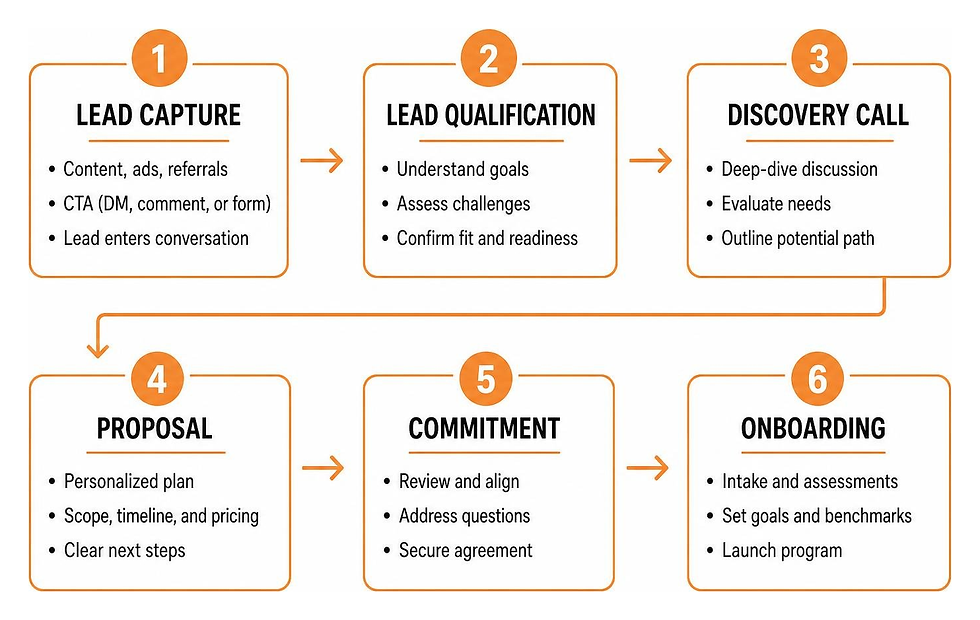
Whether you work independently or are scaling a boutique facility, mastering sales conversions and client retention stabilizes your cash flow. If you operate an advisory or fitness consultancy practice along the Atlantic seaboard, review our specialized guide on lead generation for coaches east coast.
Paid Fitness Trainer Marketing and Conversational Funnels
Once you have validated your core offer organically, paid advertising serves as an efficient growth accelerator. Avoid sending paid ad traffic to complicated, multi-step website landing pages. In the fitness niche, conversational Click-to-DM or Click-to-WhatsApp Meta Ads (Facebook and Instagram) regularly deliver lower costs per lead.
Deploying a straightforward campaign targeting a 5-to-15-mile radius around your facility with a clear hook (such as an introductory assessment or a local transformation program) consistently books appointments. If you prefer to bypass technical ad configuration entirely, look into our done for you lead generation for coaches solutions.
For an international perspective on funnel automation, consult this guide to digital marketing for fitness trainers, explore this French resource on digital marketing for sports coaches, or review this Korean guide outlining a no-nonsense personal trainer marketing checklist.
Developing a Systematic Client Referral Engine
Word-of-mouth is powerful, but passive word-of-mouth is unreliable. Research reveals that 83% of happy clients are willing to provide referrals when asked, yet only 29% do so on their own.
Referred clients are exceptionally valuable: they convert at 3 to 5 times the rate of cold leads, stay 37% longer, and spend 16% more.

To build a reliable referral engine:
Time the Request at Milestone Moments: Ask for referrals immediately following a personal record, a noticeable body composition check-in, or when a client spontaneously expresses appreciation.
Provide Dual-Sided Incentives: Offer a reward that benefits both parties, such as giving the existing client a free session or branded apparel while gifting their friend a complimentary 30-minute diagnostic movement assessment.
Establish Cross-Referral Strategic Alliances: Partner with non-competing local professionals, including physical therapists, registered dietitians, chiropractors, and massage therapists. Cross-referral partnerships ensure a steady flow of pre-qualified clients.
Diagnostic Consultations and High-Touch Onboarding
Offering a generic "free workout" often attracts bargain-hunters with low commitment. Instead, position your initial consultation as a Diagnostic Movement and Goal Assessment.
During this 30-to-45-minute session:
Conduct a formal movement screen to identify mobility restrictions, posture imbalances, and strength discrepancies.
Discuss their training history, past injuries, lifestyle habits, and concrete targets.
Prescribe a tailored roadmap explaining exactly how your training package solves their specific limitations.
Trainers who implement structured diagnostic sessions routinely convert 60% to 70% of consultations into paid clients. Follow up with a frictionless onboarding process—using specialized coaching software for digital intake forms, liability waivers, payment processing, and program delivery—to build confidence from day one.
Frequently Asked Questions about Fitness Trainer Marketing
How much should a personal trainer spend on marketing each month?
New trainers should focus primarily on free, high-sweat-equity channels: optimizing their Google Business Profile, creating targeted social content, engaging with local networks, and asking existing clients for referrals.
When transitioning to paid acquisition, an initial budget of $300 to $500 per month on Meta Ads running over a 60-to-90-day window provides sufficient conversion data to generate 20 to 50 localized inquiries without overextending capital.
What is the fastest way for a new fitness trainer to get clients?
The fastest route requires zero ad spend: direct relationship building and network activation.
Start by offering complimentary, high-value movement screenings to members on your gym floor, re-engaging your personal and professional contacts with a clear launch offer, and setting up cross-referral agreements with local physical therapists and sports doctors.
How do personal trainers measure the ROI of their marketing campaigns?
Vanity metrics such as likes, video views, and follower counts do not pay business expenses.
Track clear commercial indicators:
Cost per Lead (CPL): Total marketing spend divided by total qualified inquiries.
Consultation Booking Rate: Percentage of leads that schedule a diagnostic assessment.
Close Rate: Percentage of assessments that convert into paying package clients.
Client Lifetime Value (LTV): Average duration a client trains multiplied by their recurring monthly investment.
Conclusion
Filling your personal training calendar does not require virality or constant hustle. Sustainable growth relies on clear positioning, dominating local search, publishing helpful educational content, and running a structured referral and consultation system.
When you treat client acquisition as a measurable business process rather than a guessing game, you break free from the feast-or-famine cycle for good.
To implement an end-to-end framework that consistently brings high-intent buyers into your business, discover our full client acquisition system for coaches and take complete control of your growth.


Comments