

From Cold Calls to the OR: A Strategic Guide to Medical Device Sales Coaching

Why Medical Device Sales Coaching Must Go Beyond the Ride-Along

Medical device sales coaching works best when it helps reps diagnose real account barriers, practice high-stakes conversations, and leave each session with one clear next step. Managers should coach from observable evidence, ask more questions than they answer, and prepare reps to build support across clinical, operational, and financial stakeholders.
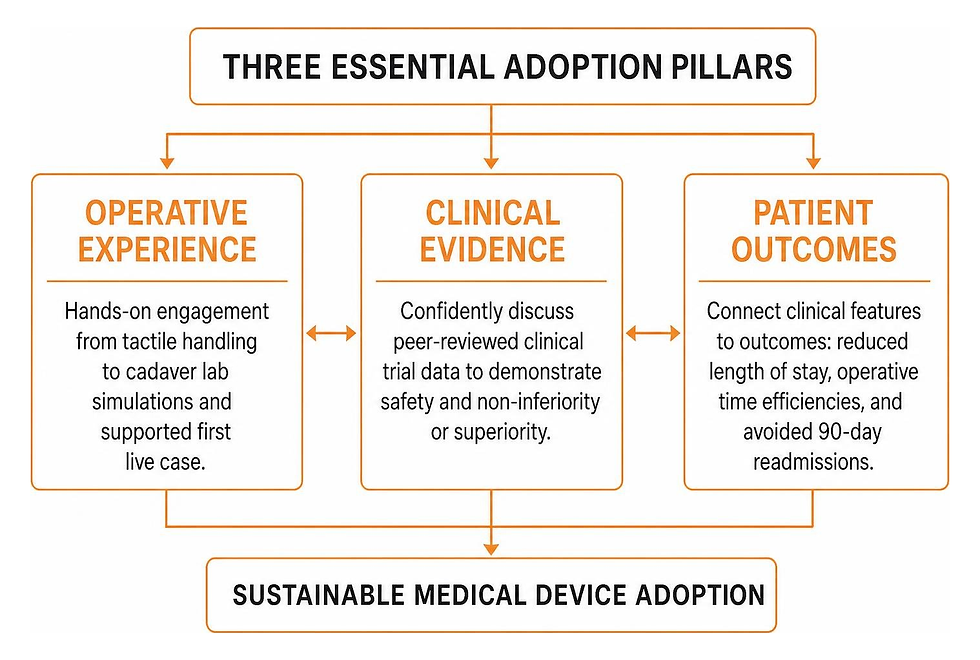
This matters because a hospital sale is rarely won by a strong product pitch alone. Reps must earn surgeon trust, protect OR workflow, and make a credible value case to the Value Analysis Committee. Effective coaching helps them strengthen all three adoption pillars: operative experience, clinical evidence, and patient outcomes.
The goal is not a post-call "autopsy" where a manager lists mistakes. It is a repeatable system that builds independent thinking before the next surgeon meeting, committee review, or first clinical case.
Alpha Coast works with career and executive coaches, consultants, and service experts, including those who specialize in medtech sales leadership and commercial team development, helping them build reliable client-acquisition systems so they can focus on delivering exactly this kind of high-value coaching. The same principles behind strong medical device sales coaching apply to how these coaches should run their own practices: diagnose the real constraint, use evidence over assumptions, and create clear accountability without removing ownership from the person doing the work.

Modernizing Field Performance: Frameworks for Medical Device Sales Coaching
Traditional field coaching in the medtech industry has long relied on the "ride-along autopsy." A sales leader spends a day riding passenger in a territory rep's car, watches three hospital interactions, and then delivers an exhausting list of everything the representative did wrong on the drive home. This unstructured feedback deflates morale and fails to alter commercial execution.
Modern healthcare commercial organizations require performance diagnostics grounded in structured methodology. When leaders embrace structured sales coaching, they move away from subjective impressions and transition toward observable, repeatable behaviors that elevate win rates across complex health systems.

Implementing the GROW Model in Medical Device Sales Coaching
The GROW model (Goal, Reality, Options, Way Forward) transforms coaching by shifting ownership of problem-solving directly onto the sales representative. Outlined in structured leadership frameworks, this methodology systematically dismantles the destructive habit of manager-led dictation.

To build genuine field independence, managers must enforce the ask-not-tell rule, maintaining an 80/20 dialogue ratio where the leader asks 80% of the questions and the representative does 80% of the talking:
Goal: Establish the concrete objective of the interaction. "What specific clinical commitment were you aiming to secure with Dr. Vance?"
Reality: Examine what actually transpired without emotional bias. "When the surgeon mentioned satisfaction with their current fixation construct, what discovery question did you ask next?"
Options: Prompt the representative to explore alternative tactical maneuvers. "What are three different ways we could frame the revision risk data to prompt a re-evaluation?"
Way Forward: Solidify a verifiable commitment. "Which of those approaches will you apply during Thursday's pre-op debrief, and when will we review your notes?"
When reps show defensive reactions during feedback, exceptional coaches treat that defensiveness as data rather than insubordination. Defensiveness highlights an underlying anxiety regarding clinical credibility or territory numbers. By staying curious and anchoring the discussion back into the structured GROW framework, sales leaders de-escalate tension and protect emotional regulation.
Leveraging Conversation Intelligence and Objective Evidence
Memory is inherently subjective. When a manager says, "You pitched pricing too early," a representative instinctively defends their timing. By implementing conversation intelligence platforms like Gong alongside role-play simulations, leadership replaces subjective opinion with timestamped evidence.
Reviewing recorded virtual Value Analysis Committee (VAC) touchpoints or clinical pre-planning sessions allows coaches to highlight exact conversational turns. Applying modern inside sales coaching methods to medtech allows field teams to analyze talk-to-listen ratios, competitor mention cadences, and customer objection patterns with analytical precision.

When field representatives review their own conversational metrics, cognitive dissonance dissolves, paving the way for measurable tactical improvements.
Navigating Hospital Buying: The Three Pillars and Stakeholder Triad
Winning institutional medtech deals requires mastering multi-stakeholder healthcare dynamics. Hospital buying groups frequently involve 6 to 10 distinct decision-makers, each operating with conflicting incentives. Developing commercial teams to navigate these matrixed environments requires strategic leadership sales coaching focused on organizational alignment.
Stakeholder Role | Primary Priority | Primary Operational Risk | Essential Coaching Focus |
Surgeon Champion | Patient outcomes, tactile feel, surgical efficiency | Intraoperative failure, learning curve disruption | Hands-on cadaver lab execution, peer clinical literature |
OR Director | Tray setup turnaround, room scheduling, sterile processing | Turnover delays, lost surgical block time | Inventory consolidation, staff in-service training protocols |
VAC Chair | Total cost of care, reimbursement viability, readmission risk | Unbudgeted acquisition cost, non-coverage | Length-of-stay reduction, 90-day bundled payment economics |
Mastering the Three Essential Adoption Pillars
Sustainable medical device conversion depends on establishing three interconnected pillars:
Operative Experience: Clinicians rarely switch procedural habits based on slide decks. The single highest-leverage catalyst in procedural sales is hands-on engagement—transitioning from dry-lab tactile handling to formal cadaver lab simulations, followed by a supported first live operative case with a clinical specialist scrubbed in.
Clinical Evidence: Reps must move beyond surface-level brochure claims and confidently debate peer-reviewed, published clinical trial data, demonstrating procedural safety and non-inferiority or superiority over incumbent standards of care.
Patient Outcomes: Value cases must directly connect clinical features to macro healthcare metrics, specifically reductions in length of stay (LOS), operative time efficiencies, and the avoidance of costly 90-day readmissions.
Orchestrating Parallel Stakeholder Conversations
A common failure mode in device sales is securing surgeon enthusiasm while neglecting procurement gatekeepers, only to have the product rejected by hospital administration. Sales leaders must train reps to run simultaneous, parallel workstreams across the stakeholder triad.
Coaching must prepare reps to build a comprehensive pre-VAC packet on the exact day the surgeon commits to a cadaver lab trial. Rather than succumbing to demands for margin-eroding price discounts, reps must be coached to construct a total-cost-of-care defense.
When a committee challenges an 8% to 11% device price premium, a well-coached representative clearly shows how saving 22 minutes of OR turnover time and reducing wound complications by 1.8% yields an overall net financial gain for the hospital's surgical service line.
Enterprise Onboarding and Market Development Methodologies
Ramping new commercial hires in medtech requires far more than generic product modules or LMS certifications. Transforming new personnel into clinical peers demands sophisticated, high-ticket sales coaching programs that blend procedural rigor with strategic commercial acumen.

Long-Term Field Mentorship and Clinical Protocols
Industry leaders demonstrate that elite commercial execution is built on extensive, structured mentorship. In The Coaching System Behind High Performing Sales Teams w/ Sharla Wendt, enterprise leaders such as BD highlight the power of pairing new hires with senior field trainers for 18 to 24 months of shoulder-to-shoulder development.
This structured trajectory consists of a phased onboarding curriculum:
Phase 1 (Month 1): Intensive one-week anatomical, product, and regulatory safety training.
Phase 2 (Months 2–3): Live field observation, scrubbing into procedures, and mapping account politics.
Phase 3 (Months 4–6): A two-week advanced sales application training incorporating realistic surgical role-plays, handling specialized surgeon objections, and conducting procurement simulations.
Phase 4 (Months 6–24): Ongoing field co-travel, structured pre-call planning, and dedicated peer-to-peer coaching networks.
Leading organizations also deploy specialized clinical protocol teams. Operating with strict operational separation from transactional sales targets, these clinical implementation specialists install standardized care pathways within hospital departments. This structural firewall establishes pure clinical credibility, validating procedural efficacy through real patient metrics before sales teams pursue expanded enterprise-wide contracts.
Uncovering Latent Needs in Developing Clinical Markets
When launching disruptive technologies into greenfield or developing markets, reps encounter clinicians who do not believe they have an existing procedural problem. Standard product pitching in these scenarios triggers immediate clinical skepticism.
Coaching must guide reps to leverage comparative facility analytics and interactive clinical outcome calculators. By presenting blinded, risk-adjusted performance data, reps show surgical teams how their local infection rates, revision rates, or procedural durations benchmark against national averages.
This consultative approach generates a groundswell of organic clinician interest, unseating entrenched habits through undeniable clinical proof.
Advanced Execution: Portfolio Mastery, Elite Autonomy, and Failure Modes
As medical device organizations expand through acquisition and internal innovation, sales leaders face a critical organizational challenge: getting sales representatives to sell the full breadth of the portfolio rather than relying solely on legacy, high-comfort products.
Strategic business development coaching diagnoses and remedies the behavioral economics driving field behavior.
Common Failure Modes in Medical Device Sales Coaching and How to Fix Them
When reps neglect secondary product lines, leadership often defaults to punitive management or generic calls to "work harder." In practice, field reps naturally focus on mature flagship products because they reorder with minimal administrative effort. Launch lines, by contrast, demand extensive VAC submissions, nursing in-services, and trial coordination.
To correct this dynamic, sales leaders must implement a Weighted Portfolio Scorecard:
Define Core KPIs: Limit performance metrics to 8 or 9 observable operational activities across both mature and launch lines.
Assign Strategic Weights: Allocate percentage weightings totaling 100 points, assigning 40% to 50% of total emphasis directly to strategic growth portfolios.
Establish Clear 1-to-5 Proficiency Tiers: Anchor performance levels with unambiguous behavioral milestones (e.g., Level 1 = No VAC packet submitted; Level 5 = Standing order status across three regional health systems).
Gate Variable Compensation: Wire quarterly bonus accelerators directly to composite scorecard attainment rather than gross revenue volume alone.

Balancing Autonomy and Accountability for Elite Performers
Managing veteran, high-performing medical sales representatives requires a delicate balance between operational discipline and professional autonomy. Elite performers resist micromanagement, yet unmonitored territories risk blind spots and pipeline stagnation.
Leaders achieve predictable revenue growth by establishing structured, monthly pipeline audits paired with wide tactical autonomy. When managers set clear outcome metrics—such as accounts active in cadaver lab pipelines, VAC submission velocity, and cross-portfolio penetration—top-tier representatives are empowered to strategize their accounts independently, while maintaining clear commercial alignment with enterprise objectives.
Frequently Asked Questions About Medical Device Sales Coaching
How does the ask-not-tell rule improve rep autonomy during field coaching?
Telling a sales representative what to do creates managerial dependency; the rep executes instructions without understanding the underlying strategic rationale. By asking targeted, open-ended GROW questions, managers force representatives to engage in critical problem-solving, evaluate clinical objections, and independently devise tactical recovery strategies during high-stakes operating room discussions.
How should sales managers handle defensive reps when reviewing call recordings?
Sales managers should view defensiveness as a valuable diagnostic signal rather than insubordination. De-escalate defensiveness by validating the pressure of complex clinical environments, pausing the recording, and reframing the conversation around shared objectives. Anchor the feedback entirely in observable markers: "Let’s look at the timeline when the VAC chair asked about disposal costs. What alternative question could uncover their real budget threshold?"
What is the most effective way to coach reps on overcoming Value Analysis Committee objections?
The most effective coaching approach focuses on building a total-cost-of-care defense well before the formal committee convenes. Train reps to conduct informal "pre-read" sessions with the VAC chair and surgical services director, arming the surgeon champion with clinical safety data while addressing supply chain, tray turnover, and reimbursement economics beforehand to prevent surprise committee vetos.
Conclusion
Elevating medtech commercial teams requires leaving outdated field-ride habits behind. By institutionalizing structured GROW frameworks, harnessing conversation intelligence for objective skill analysis, mastering the multi-stakeholder healthcare dynamic, and aligning compensation with balanced portfolio execution, commercial leaders cultivate resilient sales organizations capable of navigating modern healthcare systems.
For the career and executive coaches who advise these commercial leaders, or who build practices around medtech and healthcare sales coaching, the challenge is the same one Alpha Coast solves every day: consistently connecting with the right ready-to-buy clients so coaching capacity is spent on delivering results, not chasing leads. Explore our specialized sales coaching for executives to transform your field leadership and accelerate organizational growth.



Comments