

What a Top Financial Advisor Marketing Coach Can Do for Your Practice

Why a Financial Advisor Marketing Coach Can Change Your Growth Path

A financial advisor marketing coach helps you turn scattered marketing into a repeatable client-acquisition system. The right coach should help you clarify your niche and message, choose channels that fit your buyers, build compliant outreach and follow-up, and track the numbers that lead to booked meetings and new AUM.
This is different from generic business coaching. Financial advisors face long trust-building cycles, regulatory review, complex offers, and prospects who rarely make fast decisions. A specialist can help connect positioning, content, outreach, lead nurture, and sales conversations into one system instead of asking you to rely on referrals, random posting, or costly tactics with no clear attribution.
The goal is not more marketing activity. It is a reliable pipeline that continues generating interest while you serve clients, lead your firm, or take time away from the office.
I am Kent Vanho, founder of Alpha Coast. I have helped more than 400 service-based experts build predictable inbound pipelines through positioning, buyer-intent research, outreach, automation, and done-for-you appointment-setting systems - experience that informs how I evaluate what a financial advisor marketing coach should actually deliver.
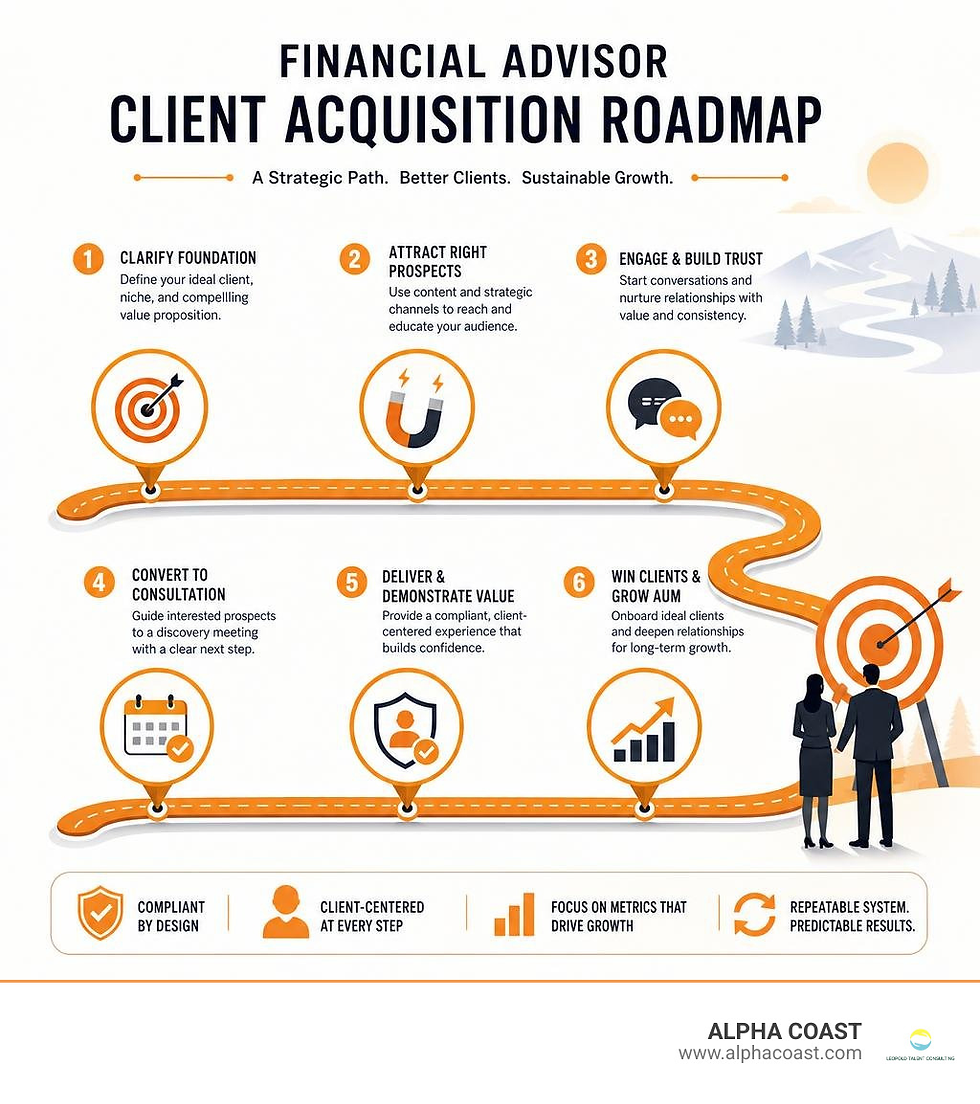
The Core Role of a Financial Advisor Marketing Coach
Marketing wealth management services requires balancing strict regulatory oversight with complex relationship-building. Many wealth managers attempt to apply tactics taken from ecommerce or SaaS, only to realize that affluent investors do not make life-altering financial decisions based on a single click.
A dedicated advisory marketing coach analyzes your current assets, refines your core message, and builds predictable conversion funnels that align with fiduciary obligations. As we emphasize in our coach marketing ultimate guide 2026, strategic alignment across your audience, messaging, and operational delivery is what separates high-growth practices from those spinning their wheels.
Specialized Industry Knowledge vs General Business Coaching
General business coaches often suggest strategies that trigger immediate compliance reviews or fall flat with high-net-worth (HNW) prospects. Wealth management requires an understanding of:
Fiduciary Standards & Regulatory Guardrails: Marketing must align with SEC guidelines and FINRA rules regarding performance claims, client testimonials, endorsements, and third-party ratings.
Extended AUM Sales Cycles: The transition of significant assets takes time. A generic coach focused on fast sales fails to design the multi-touch trust architecture required for a prospect to move accounts.
Sophisticated Audience Differentiation: High-net-worth business owners, corporate executives with equity compensation, and retirees each require distinct messaging.
Trust Architecture: Credibility in financial services is rooted in technical competence, emotional connection, and institutional stability—not aggressive pressure tactics.
Common Growth Bottlenecks and Messaging Mistakes
Left to their own devices, financial advisors frequently make preventable marketing errors:
Vague Positioning: Pitching comprehensive financial planning to everyone means appealing to no one. Specializing in a well-defined niche clarifies your offer and drives faster pipeline momentum.
Hidden or Confusing Fee Structures: Modern prospects value upfront clarity. Hiding your fee model causes friction before a discovery call is ever booked.
Over-Reliance on Word-of-Mouth: Relying purely on referrals creates feast-or-famine cycles. A steady practice requires an intentional client acquisition engine.
Marketing Noise and Decision Fatigue: Trying to manage multiple disparate platforms—from disconnected social channels to uncoordinated email tools—burns out internal staff without producing qualified discovery meetings.
Growth Stages: When Does Hiring an Advisory Coach Make Sense?

The decision to invest in marketing coaching depends heavily on the operational maturity and growth stage of your firm.
Navigating Plateaus and the Rule of 3 and 10
Advisory firms often encounter friction at predictable revenue milestones, known as the Rule of 3 and 10. As an RIA grows from $1M to $3M, and eventually approaches $10M in annual revenue, the firm's operational structure, client onboarding, and lead-generation channels experience capacity strains.
At the $3M threshold, the founding advisor can no longer handle all client advisory duties while personally driving business development. An advisory coach helps transform the founder from a solo producer into a CEO, establishing marketing systems that develop next-generation advisors and build an institutional business development engine.
Done-For-You Infrastructure vs Hands-On Coaching
Choosing the right partner requires deciding between strategic coaching and done-for-you (DFY) growth infrastructure. For firms exploring client acquisition models, choosing the right method depends on team capacity and technical readiness:
Evaluation Dimension | Strategic Marketing Coaching | Done-For-You (DFY) Systems |
Primary Focus | Skill development, strategic clarity, positioning | Pipeline architecture, outreach execution, qualified bookings |
Time Investment | 5–10 hours/week of internal execution | Minimal advisor time; focus remains on discovery calls |
Implementation Speed | Moderate (build while learning) | Rapid (pre-built infrastructure launched quickly) |
Best Fit For | Solo practitioners, advisors building internal teams | Scaling boutique RIAs, capacity-constrained partners |
Internal Requirements | Dedicated staff to execute campaigns | In-house sales capacity to close qualified appointments |
Firms wanting hands-on instruction to build capabilities internally benefit from strategic coaching. Conversely, busy teams seeking qualified meetings without taking on extra campaign work often prefer done-for-you lead generation for business coaches and wealth practices.

Systems and ROI: What an Advisory Coaching Program Actually Builds
A structured coaching relationship is an investment designed to yield measurable business equity. Research from Baruch College demonstrated that while standalone training programs improved managerial productivity by 28%, pairing training with structured coaching drove an 88% productivity increase.
Data within the financial services sector mirrors this dynamic: advisors who implement disciplined business coaching models have achieved revenue compound annual growth rates (CAGR) reaching 19.9% over multi-year periods, outperforming baseline market growth.
Core Systems Implemented by a Financial Advisor Marketing Coach
A dedicated marketing coach helps advisors implement key operational engines to attract high paying clients:
Targeted Lead Magnets and Webinar Funnels: Structuring educational webinars that address complex financial issues (e.g., concentrated stock options or estate tax minimization) to engage hundreds of qualified registrants.
Evergreen Email Nurture Sequences: Automated, compliance-approved email workflows that provide ongoing market perspectives, turning cold contacts into booked appointments.
Systematic LinkedIn and Inbound Outbound Campaigns: Direct, professional outreach frameworks that initiate conversations with target corporate leaders and business owners without resorting to generic spam.
Evaluating Return on Investment Across Growth Investments
When evaluating growth capital, advisors often weigh coaching against hiring a junior advisor or buying cold lists. While adding a junior advisor adds immediate fixed overhead and requires extensive onboarding, optimizing your marketing delivers scalable leverage.
Improving your marketing campaign efficiency by 20% to 25% on an active media spend can yield tens of thousands of dollars in annual savings, while sharpening your positioning supports higher fees. Pair this with dedicated sales coaching to convert discovery conversations into signed advisory agreements, and the compounding returns far outweigh the initial coaching fees.
How to Vet and Select the Right Strategic Partner
Selecting the wrong marketing coach leads to lost revenue, regulatory headaches, and operational frustration.
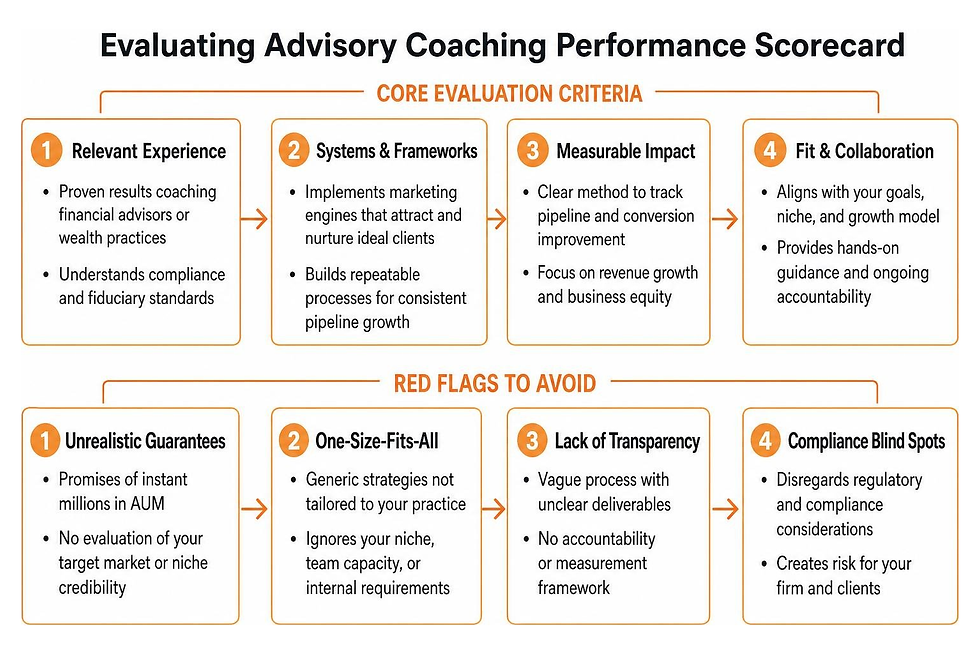
Critical Red Flags to Avoid in Coach Selection
Be cautious of these common red flags when vetting a prospective advisor coach:
Unrealistic Pipeline Guarantees: Any coach promising instant millions in AUM without evaluating your target market or niche credibility should be avoided.
Generic Mastermind Models: Large group masterminds where an advisor receives only 15 minutes of direct attention per month rarely solve complex operational bottlenecks.
Unvetted, Instant Consultations: Professional coaches protect their time and vet candidate firms via discovery applications before scheduling strategy sessions.
Bargain-Basement Pricing: Coaches charging low monthly rates often lack deep wealth management experience or rely on cookie-cutter templates.
Lack of Industry Specialization: Coaches who primarily serve local brick-and-mortar businesses cannot navigate SEC advertising rules or institutional sales cycles.
Essential Checklist to Evaluate a Financial Advisor Marketing Coach
When vetting potential partners, review these essential criteria to ensure they can deliver qualified coaching leads and predictable growth:
Compliance Awareness: Can the coach speak intelligently about testimonial rules, performance disclosures, and third-party rankings?
Documented Track Record: Do they have case studies demonstrating verified AUM growth across independent RIAs and advisory practices?
Structured Engagement Rhythm: Does the program utilize bi-weekly or monthly strategic calls paired with action items and measurable scorecards?
Asset & Message Alignment: Do they assist with high-level value propositions, lead magnets, and targeted outreach scripts?
Frequently Asked Questions About Advisor Marketing
What is the typical fee structure and format for advisory coaching?
Most high-tier marketing coaches work on monthly retainers ranging between $2,500 and $5,000 per month, or offer 90-day execution sprints priced between $8,000 and $15,000. Engagements usually include two 60- to 90-minute strategic sessions per month, ongoing asset reviews, and direct email or messaging access for real-time campaign adjustments.
How long does it take to establish a predictable outbound pipeline?
While initial outreach campaigns can generate engagement within 30 to 60 days, establishing a fully predictable, evergreen client-acquisition engine typically takes three to six months. This period provides sufficient time to refine audience targeting, test messaging, and optimize sales conversions across complete review cycles.
How do coaches ensure marketing strategies remain compliant?
Experienced advisor marketing coaches build every campaign with compliance requirements in mind from day one. This includes using standardized disclaimers, adhering to SEC marketing regulations regarding testimonials and endorsements, and delivering complete message archives for your Chief Compliance Officer (CCO) to review and approve before launch.
Conclusion
A skilled advisory marketing coach helps you move away from uncoordinated marketing tactics and build a dependable client acquisition engine. By clarifying your ideal client profile, automating lead nurture workflows, and refining your value proposition, your firm can achieve predictable AUM growth while freeing you to focus on client service and strategic leadership.
For advisory firms seeking high-growth outcomes without the burden of building and managing internal outbound campaigns, exploring an end-to-end client acquisition system for coaches provides a direct route to connecting with high-intent prospects predictably.


Comments